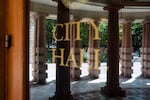
FILE - Pillars mark the entrance to Portland City Hall, reflected in the door, in Portland, Ore., on July 9, 2026.
Eli Imadali / OPB
Portland City Council took the rare step of compromising on a budget proposal Wednesday, following a meeting that once again showcased a divided council and featured a first-of-its-kind vote by Mayor Keith Wilson.
The roughly $10 million spending package saves 30 city employees who were slated to lose their jobs next month across the city and puts $3 million toward police training programs.
The vote follows a bruising budget season, where councilors struggled to compromise on spending packages, leading to many failed 6-6 votes and accusations of stubborn obstructionism across the dais.
Wednesday’s decision showed a slight change, with a 10-2 vote to advance the spending plan.
“I think we have an opportunity right now to show a council win,” said Councilor Olivia Clark, one of the four councilors who introduced the proposal, before casting her vote.
But the proposal’s passage followed a more fraught funding debate. The $10 million plan, led by Clark and Councilors Steve Novick, Elana Pirtle-Guiney and Loretta Smith, was one of two proposals considered Wednesday.
The other, led by five of the more progressive members of council, would have preserved 55 jobs and cost about $18 million. That plan was voted down after councilors called on Wilson to break a 6-6 tie, a feature of the city’s new form of government. This was the first time Wilson, who voted against the progressives’ plan, had been tapped to break a council tie.
Councilor Mitch Green, one of the proposal’s sponsors, said it was a bad sign.
“I don’t think it’s good to see the responsibility and obligation of this body to come to a final conclusion on its actions with a mayor tiebreak,” said Green. “I know that there are some of my colleagues who think that that’s something we should rely upon all the time, but I do not.”
Portland City Council adopted its $8.5 billion budget last month after weeks of thorny debate between councilors over ways to save city jobs and programs slated to be cut. Yet disagreement over how to fund those jobs and which ones should be saved resulted in little change. The final budget cut roughly 140 jobs. Since many of those positions were vacant, that meant 99 people were headed to a layoff in August.
Just days after the budget passed, two groups of councilors pitched dueling proposals to save those jobs from the chopping block.
Five progressive councilors — Green, Angelita Morillo, Candace Avalos, Sameer Kanal and Tiffany Koyama Lane — introduced a plan to save jobs by using interest accrued by the city’s climate fund tax and other contingency funds.
These jobs were also preserved in the other proposal, adopted Wednesday, led by the four slightly more moderate councilors. But that proposal looked toward a different funding source. Along with contingency dollars, the proposal relies on “other funds,” which could include unused dollars in the Office of Community Police Accountability, or OCPA.
That office, created by voters in 2020, has taken longer than expected to get up and running — and slow to spend its $16 million budget. Using this money to patch budget gaps came up repeatedly during this year’s budget debates. The idea was repeatedly rejected by the more progressive half of the council — and continued to be a nonstarter in the latest budget proposal.
This concern was slightly reduced through an amendment introduced last week by Council President Jamie Dunphy, which explicitly removes mention of tapping the police oversight budget. Instead, the amendment directs the city’s budget office to consider using the climate fund interest and other general fund underspending that office identifies.
Yet it doesn’t outright prohibit the budget office from using that police accountability fund, leaving that door open.
Several councilors who supported the Clark-led proposal urged the city’s budget office to avoid using the police accountability fund.
“Moving forward, if this touches the OCPA,” said Morillo, “I will make sure I will do everything in my power legislatively to protect it moving forward.”
Councilors Avalos and Koyama Lane voted against the spending package. Avalos argued that her plan also incorporated input from critical councilors to reach a compromise, but wasn’t given the same respect.
“I don’t understand how you could possibly say that you all compromised on something that you didn’t bother to work with us on,” she said. “Compromise needs to work both ways.”
Those who voted against the progressives’ spending package said they thought the $18 million price tag was too large and could lead to further budget cuts next year.
The approved funding plan restores positions in the city’s parks, transportation, police, fire and water departments. Pirtle-Guiney said Wednesday’s vote brings stability to city staff who were preparing for unemployment.
“We have the opportunity to provide certainty to our city employees who have been dealing with this whiplash,” she said.
The plan also extends healthcare coverage to October for the roughly 70 city employees still slated to lose their jobs next month.