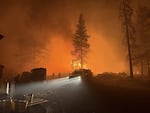
Crews provide structural protection for private residences in the path of the Akawa Butte Fire near Sisters, Ore., July 21, 2026.
Courtesy of Oregon Department of Forestry / via InciWeb
Firefighting crews are working around the clock to contain the dozens of wildfires burning across Central, Eastern and Southern Oregon.
The Oregon Department of Forestry is coordinating with state, local and federal agencies to contain large wildfires that have triggered level 1, 2 and 3 evacuations and led to air quality advisories in more than a third of the counties in the state.
The agency’s complex incident management teams have taken command of the Akawa Butte fire burning near Sisters and are assisting on several fires that are part of the Rowe Creek Complex.
A state-to-state mutual aid agreement has allowed ODF to get help from Florida firefighters who took over command on Monday of the Evans Creek fire in Southern Oregon.
Kyle Williams, ODF’s Deputy Fire of Fire Operations, joins us for more details.
Note: The following transcript was transcribed using AI and validated for accuracy, readability and formatting by an OPB volunteer.
Dave Miller: This is Think Out Loud on OPB. I’m Dave Miller. We start today with an update on wildfires burning across Oregon. The center of the state has the most fires, but crews are also battling blazes in Southwestern and Northeastern Oregon. Residents in about a third of Oregon counties have received air quality advisories. More than 6,000 Oregonians are under “Go Now” evacuation orders.
Kyle Williams is the Deputy Director of Fire Operations at the Oregon Department of Forestry. He joins us now. It’s great to have you back on the show. Thanks very much for making time for us.
Kyle Williams: You bet.
Miller: What does the overall fire map of the state look like to you right now?
Williams: It’s incredibly busy out there. In terms of where it fits into what somebody might think of as a normal fire season, it’s on pace at the moment to exceed 2024, which was at that point the most acres that we had burned, at least in modern recorded history, in Oregon. So as I look at that fire map, it tells me that it’s as much as we could possibly have on the landscape at one time. It’s really testing all our firefighters and our system from corner to corner.
Miller: I want to talk about the way you’ve been responding to that test. It’s worth saying – you were getting at this – it’s still only July. We have a lot more dry, sunny, potentially lightning-filled weeks or months to come. But let’s turn to some of the specific fires. The Akawa Butte Fire was named the number one priority fire in the country a couple of days ago. What does that designation mean?
Williams: It’s a great question. So what it indicates is that, of all the fires nationally, it has been ranked based on priorities of protecting communities, homes, life, infrastructure, you name it. It was the greatest threat to impacting those things of any fire across the country. We work in a system that goes from the local resource up to the entire national system. And when you get to that national system, you’re trying to prioritize where the limited government firefighting resources go first, when you’ve got a lot of different places that need them. When you’re at a fire that’s ranked number one, if something comes available, that’s where they send it first.
Miller: And this is because of proximity to Sisters?
Williams: At the time, absolutely, yep.
Miller: What’s the status of that fire today?
Williams: That’s actually a bit of a good news story in the midst of everything that we have going on right now … sort of good news, bad news. Last Thursday afternoon, it was making a hard push south into the town of Sisters. It got a brief shot of rain associated with some thunderstorms, and it provided about a 12-hour window for our incident management team and the firefighters who were out there to jump on it. They were able to get a line around it. Then it took a couple of days hanging on, catching a couple of spot fires, and putting them back inside the line. As of today, they’ve got a line all the way around it and they’re feeling pretty good that they’re gonna be able to hang on to it where it currently sits.
Miller: You did say that you’ve got good news, bad news. So what is the bad news right now?
Williams: The bad news that afternoon was that the brief shot of rain that provided that opportunity to catch Akawa put down a bunch more lightning across Central and Eastern Oregon. While we already had significant fires on the landscape, we ended up with a bunch of new ones. Followed by, on Saturday, extreme fire weather conditions: 30-mile-an-hour winds, low RHs [relative humidities], high temps. We saw explosive growth on new fire starts from basically The Dalles all the way out to Jordan Valley on many of those fires.
Where it gave us a chance to catch Akawa, it pushed many other fires really fast, and now we’re trying to get our arms around those two. “We” being the entire system: Forest Service, BLM, local Fire Service, Oregon State Fire Marshal. Everybody is working together, as best we can, to try and get around these fires.
Miller: You mentioned lightning there. At this point, how much do you know about what’s caused these various fires?
Williams: For the most part, it has been lightning. We’ve had poor luck and bad weather. And we knew this. The setup coming into this summer with the snow drought, and historically, high fire danger conditions coming into the summer, it was just a matter of what volume of starts were we gonna have?
It kicked off July 10 with the East Evans Creek fire down in Southwest Oregon. Then each Thursday it seems like we get another round of lightning followed by a couple of days of wind, high temperatures and low relative humidities. So it’s been predominantly lightning, up to this point.
Miller: So let’s turn to the test, as you put it earlier. What are the challenges right now when there are this many fires, some of them threateningly close to population areas, in allocating resources?
Williams: That’s really difficult when you’ve got multiple fires, especially thinking about that area around Burns and southeast of Burns over the last couple of days. Fires that in a couple of hours, one of them made a six-mile run in three hours. So, you might have a crew and some intermediate overhead. So we’ve got line managers that go out and make sure that resources are directed and safe as they’re taking that action. You might begin a process of putting in a dozer line, and an hour later, that fire is already two or three miles away from you.
That means we’ve got to get more folks out here to try and get a safe span of control. When you’re doing that across [the state] – we’ve got 32 large, uncontained fires in the state right now, and it’s down from 34 because a couple of them merged recently – it becomes really hard. You spread that intermediate line management out so far, you have to be really careful to keep people safe and be effective while you’re doing that. That’s where we’re being tested the most right now, is in that safe, well-coordinated and communicated firefight.
Miller: How would you say the coordination with federal and state partners is working right now?
Williams: I would say seamless. I spent all of the last two weeks out on these major fires and there is no color on a map. There’s no badge on a shirt. Everybody is working together. Again, because there’s so much fire out there, there’s no time, there’s no space for someone to worry about whose part of the world is it. Everybody is trying to help everybody get around these fires. It’s been learned over the last decade in this state through some really tough fire seasons, but it’s really in action out there.
We don’t have enough people in the places we wanna be. That’s mostly at that line management scale. But what folks we do have out there are maximizing each other, leveraging each other, working very well together. Again, trying to keep people safe, keep communities safe, keep homes from being burned. Our number one priority is making sure that everyone comes home at the end of the day. That is requiring phenomenal teamwork right now.
Miller: The good coordination and good communication is great news, especially given that there had been some concerns specifically about the U.S. Forest Service or other federal partners, BLM as well, given that a number of managers at various levels took buyouts or saw job losses in the DOGE era. So you’re saying you have not seen any differences in terms of coordination with your federal partners?
Williams: Specific to the fire folks, no, I haven’t. There may be some stuff happening behind the scenes for them at their agencies, but in terms of our firefight and the coordination there, they’ve shown up. They’ve answered the phone. They’ve sent a helping hand. On the fire side of things, I’ve not seen disruption there.
Miller: We’re talking about local or other state partners, folks from Florida even, obviously including a lot of parts of the U.S. West. But just a couple of days ago, Governor Kotek said that fire crews from Australia and New Zealand were gonna be arriving soon. Do you know yet where they’ll be working?
Williams: I do. They just got on the ground on Monday. I mentioned earlier, we work from the local up to the national level, and the National Coordinating Center put the order into Australia and New Zealand. [They] brought out 59 line supervisor type positions, from safety officers to division supervisors, you name it. They landed over the weekend, got briefed on Monday, and they’ve been inserted into various fires all over the state, as of today.
Again, back to that prioritization process, they took those 59 folks and Paradise Fire might have gotten four of them that were of high need and Brewer Fire got four of them that were of high need. They’re trying to maximize spreading out those resources as they come to bear. But that’s a huge injection of that middle management that we’ve been desperate for.
Miller: You mentioned the weird chance of Thursdays being lightning time for a little while now. What does the weather forecast look like today, in terms of the next week or two, [for] firefighting efforts and the possibility of more lightning?
Williams: I’d say firefighters are eternal optimists. So the weather is gonna stay locked under this high-pressure system for a little bit. It still means high temperatures and low relative humidities. But even one day of a break from the wind, is an opportunity for us at the moment. On the not-so-good-news side – my unlucky Thursdays – this morning’s briefing, we had a chance in the forecast for lightning again this Thursday, mostly Central and Eastern Oregon, followed by another passage of a dry cold front on Saturday, which means winds. So, it’s almost a rinse, wash, repeat of what we’ve seen in the last couple of weeks.
The good news is over the last couple of weeks, we have brought in 14 incident management teams into the state and the region. What that does is provide us again, each day, to add more line supervision, we’re adding more organization. So if we do get initial attack starts that might happen after this next lightning event, there are going to be more and more folks who can help manage those when they’re small. We’re maximizing the amount of contractors that we can put out on the line to be able to help with that.
It’s sort of Groundhog’s Day at the moment. Hot, dry, every other day windy, but that’s what we’ve got and we’re working through it.
Miller: There’s nothing that the public can do to prevent lightning. But what do you want folks to keep in mind right now in terms of efforts to reduce human-caused fires?
Williams: I am at the point of begging the public to help us not start one more fire. You said it, we can’t control the lightning, they come through and they’ll start 20 fires in one spot at a time. You go out and you pick up as many of those as you can. And as soon as you think you got those wrapped up, someone has a mistake in judgment and they start another one behind you. That’s the one that might get away. We just can’t have another one get away that we can actually control.
Check local fire restrictions, pay attention to the weather. If you know it’s gonna be windy in the afternoon, maybe change your plans if what you’re doing could be risky. Check those tow chains on your trailer if you’re headed to go camping. Go enjoy the Oregon summer but make sure that getting there, you’re safe doing it and then you’re safe while you’re there. We really need folks to be on edge, frankly, about the actions they’re taking and how those might cause that next fire that would overwhelm our system.
Miller: Kyle, thanks very much.
Williams: Appreciate it, Dave.
Miller: Kyle Williams is Deputy Director of Fire Operations at the Oregon Department of Forestry.
“Think Out Loud®” broadcasts live at noon every day and rebroadcasts at 8 p.m.
If you’d like to comment on any of the topics in this show or suggest a topic of your own, please get in touch with us on Facebook, send an email to thinkoutloud@opb.org, or you can leave a voicemail for us at 503-293-1983.