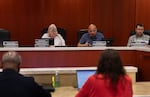
From left, Clark County Councilors Sue Marshall, Wil Fuentes and Matt Little attend a work session meeting at the Public Service Center in Vancouver, Wash., on July 29, 2026.
Saskia Hatvany / OPB
A majority of the Clark County Council is up for election this year. Three out of five seats are on the ballot in Washington and they’re all contested.
Although the roles are officially nonpartisan, the current council majority has taken progressive or liberal positions on many issues. On Tuesday, Clark County voters will have their first of two opportunities this year to decide — when it comes to issues like funding light rail on the I-5 bridge, balancing services and taxes, and building new housing — do they want a continuation of the current council’s priorities, or a change?
In the District 1 and 2 races, incumbents seeking reelection each face challenges from multiple candidates. The top two vote-getters of each race in the Aug. 4 primary will appear on the November ballot.
In an open race for District 5, there are only two candidates — former Battle Ground Mayor Troy McCoy and Clark County Charter Review Commissioner Peter Silliman. They will both advance to the general election.
| Clark County Council District | Candidate Names |
|---|---|
| 1 | Dusti Arab, Lukas Bardue, Bryan Shull, Glen Yung (Incumbent) |
| 2 | Michelle Belkot (Incumbent), Martin Pittioni, John Zingale |
| 5 | Troy McCoy, Peter Silliman |
Light rail and the I-5 bridge
Clark County has little decision-making power when it comes to the future of the Interstate Bridge Replacement Program — a potentially more than $14 billion project that will replace the seismically unfit I-5 bridge between Portland and Vancouver.
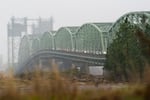
FILE- The Interstate-5 bridge in Portland, Ore., on Thursday, Dec. 4, 2025.
Saskia Hatvany / OPB
Still, the issue of the project’s hefty cost and to what extent it will involve light rail has been a wedge issue among county councilors, candidates, and voters.
The council is not directly in charge of funding or policy decisions for the bridge project, but it can pass advisory resolutions and has three of nine voting seats on the board of C-TRAN, which is one of the partner agencies on the project. The C-TRAN board can make decisions about how much local funding to allocate for light rail operating costs.
The main division on this issue is between councilors who say they want the new bridge to include light rail that extends into downtown Vancouver, and those who say they want the bridge project to be pared down to its bare necessities to reduce its ballooning price tag.
“The costs associated with adding light rail are extremely prohibitive and highly concerning,” wrote District 1 candidate Bryan Shull in response to questions from OPB, “considering the county residents have voted not to approve light rail more than once.”
Earlier this month, one of Shull’s opponents in the race, current District 1 councilor Glen Yung, introduced a resolution supporting the extension of light rail to Vancouver’s Library Square, where a new transit hub is in the works. The resolution was adopted with support from all councilors except District 2 representative Michelle Belkot, who’s running for re-election against two challengers who both support light rail.
Belkot sued the county last year after her fellow councilors voted to remove her from the C-TRAN board when she said she would vote against the county assuming any operating costs for light rail. A judge dismissed the case in March.
Balancing services and taxes
Clark County continues to deal with a persistent budget deficit brought about by a combination of rising costs, a growing population, and councilors’ decisions in recent years to forego annual 1% property tax increases, which are allowed by the state.
In June, county staff asked the council to consider a 2.5% across-the-board budget cut to address the deficit.
“I do agree on the thought process of being fair,” District 1’s Yung said during a July 2 candidate forum hosted by the League of Women Voters of Clark County, “but I think the most important thing is that we recognize there are critical services that the county provides and there are important services that the county provides.”
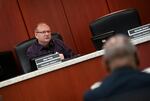
District 1 Councilor Glen Yung attends a work session meeting at the Public Service Center in Vancouver, Wash., on July 29, 2026.
Saskia Hatvany / OPB
Priorities about exactly which services to protect, and which to cut, differ among the candidates.
District 2 challenger John Zingale told voters at the forum that, “roads, parks, public safety, housing — those need to be our priorities.”
In written responses to OPB, he added, “no one really wants to increase taxes, but there are expectations of services that need to be, and should be, provided by our government.”
Meanwhile, Shull and Belkot have both said public safety is their singular top priority.
“We must manage the existing resources responsibly, cut waste, cut some staff, unfortunately, at the county level,” Belkot said during the candidate forum. “We need to prioritize core functions like law enforcement.”
About 70% of the county’s general fund currently goes toward state-mandated law and justice services. In November, voters will also decide whether to approve raising property taxes for a $366 million bond to renovate the county jail.
Building housing and navigating growth
Clark County is growing fast, and councilors and candidates are divided on how to accommodate the rising population while keeping the cost of housing in check.
Yung and Belkot were in the majority of a 3-2 vote earlier this year, when the council adopted a land-use map that allows cities including Ridgefield, La Center and Camas to expand their urban growth boundaries.
Some candidates on the ballot now say these expansions could encroach on agricultural land.
“I think we need to be prioritizing the urban centers and making sure that we are building up instead of building more sprawl,” District 1 candidate Dusti Arab said during the candidate forum. “We have a serious problem across this county with thinking that it’s appropriate to pave over farmland.”
Most of the candidates agree that building “up” rather than “out” is important. Many also want to see a faster permitting process for buildings.
“Every month a housing project sits waiting for permits adds costs that ultimately get passed on to homebuyers and renters. We can control this at the county level,” wrote District 2 candidate Martin Pittioni in response to questions from OPB. “I would love to see a pilot project experimenting with far speedier permitting, and using affordable housing projects in the pipeline as a priority in such a pilot.”
District 1 candidate Lukas Bardue echoed this sentiment in his written response.
“There is no single solution,” he said. “Increasing supply is essential, but affordability must be built into our policies rather than simply assumed.”
In the city of Vancouver alone, the population is expected to grow by about 40% over the next two decades.