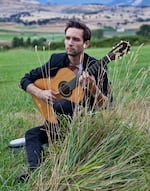
In this undated, provided photo, classical guitarist and composer Tye Austin poses for a portrait in Ashland. Austin kicked off an inaugural concert tour on Aug. 1, 2026 of more than 30 performances at 15 Oregon state parks and other outdoor locations across the state. He hopes to expand the outdoor concerts in coming years by including other musicians and venues outside of Oregon.
Courtesy Mary Landberg
Tye Austin is a classical guitarist and composer from Southern Oregon and also the founder and artistic director of Wilder Frets: Classical Guitar in the Wilderness.
The two-month concert tour, which kicked off on Aug. 1, features Austin performing original and traditional classical guitar compositions at 15 state parks and other outdoor locations, from the Central Oregon high desert to the Portland metro area, the Rogue Valley and the rugged Oregon coast. Austin is making tickets available for free or at discounted prices for people facing financial difficulties, and he’s also giving away free classical guitars and music instruction to at-risk youth.
He joins us to share how the pandemic inspired this concert series, his vision for its future growth and to perform works audiences can expect to hear.
Note: The following transcript was transcribed using AI and validated for accuracy, readability and formatting by an OPB volunteer.
Dave Miller: From the Gert Boyle Studio at OPB, this is Think Out Loud. I’m Dave Miller. Tye Austin is a classical guitarist and composer from Southern Oregon, and the founder and artistic director of a new concert tour called Wilder Frets: Classical Guitar in the Wilderness. Austin will be performing original and traditional classical guitar compositions at 15 state parks and other outdoor locations all over Oregon, from the high desert to the Oregon coast, and the Portland metro area to the Rogue Valley. The two-month long series kicked off just a couple of days ago, and Tye Austin joins us now. It’s great to have you on the show.
Tye Austin: Thank you so much for having me. I appreciate it.
Miller: Could we start with a song?
Austin: Yeah.
Miller: What do you have for us?
Austin: This is the first piece that I ever learned. It’s called “Spanish Romance,” and it was signed “Anonymous,” roughly from the 19th century.
[“Spanish Romance” by Anonymous playing, performed by Tye Austin live in studio]
Miller: That’s Tye Austin, playing “Spanish Romance.” You said that was the first song on classical guitar that you learned. Do you remember the first time you heard a classical guitar?
Austin: I do.
Miller: Where were you? When was it?
Austin: When I was 15, I was attending a music festival at the Jackson WellsSprings in Ashland, Oregon. After all the main stage acts finished, the rest of us who were at the festival gathered around a campfire and were listening to this young guitarist perform some Bob Dylan covers for hours into the starry night. And at a certain point, there was this woman who asked a gentleman to play “his style” of guitar. I was immediately intrigued. I was like, “What do you mean ‘his style?’” Doesn’t everybody just strum chords in first position and then sing over the top? He’s like, “I can’t play that guitar. It has steel strings. I have to have nylon strings. But I have my guitar in the car if you’d like me to go get it.” So he ran to his car, grabbed his guitar, and came back and proceeded to make one guitar sound like four guitars simultaneously.
And the thing that really struck out to me was that, unlike other guitarists that I had witnessed up until that point, his left hand was using all 19 frets across the entire fretboard, and his right hand was transfixed in one position. And from the angle that I was sitting, I couldn’t even tell that his right hand was moving at all or that his fingers were individually articulating, because in classical guitar, the right hand stays still up until that first knuckle, and then all the action comes from the phalange joint.
Miller: A lot of things are happening in terms of the plucking of the strings, but it’s sort of hidden by the back of the hand?
Austin: Exactly. And especially at the angle that I was sitting at, and it was at night around the campfire, it looked like he was creating sound without strumming…
Miller: Like a magic trick.
Austi: Like a magic trick! And I was immediately mesmerized, an epiphany washed over me, and I knew exactly what I wanted to do with the rest of my life. I bought my first guitar at a pawn shop for $60, and we’ve been best friends ever since.
Miller: Were you already a musician at that point? You were 15.
Austin: No, I was more interested in becoming an extreme sports athlete. I was heavily into skateboarding, snowboarding and BMX bike riding. Doing backflips, 360s and tail whips, the somersault of the extreme sports.
Miller: So it seems like one of the things that grabbed your attention was the visuals of this, seeing a right hand barely moving yet making all these amazing sounds, and the left hand moving way up and then using every single fret – as you said, all 19 frets – and then the sound that you heard. But it’s still a little bit of a mystery to me how this skateboarding kid who I think, up to this moment, wasn’t interested in making music, that your life changed in one moment. Do you understand what happened to you?
Austin: I think I do, but only in retrospect, as most things come to us. I didn’t understand it myself because I was raised by Southern parents who were from New Orleans.
Miller: Not Southern Oregon parents … Southern U.S. parents.
Austin: Yes, exactly. They were from New Orleans, Louisiana. We spent time in Tennessee as well during my childhood. So I was raised on country music. It never made sense to me, I was like why did I become interested in Spanish guitar all of a sudden? And I was perplexed, honestly.
And even in 2015, I actually went to Spain to study flamenco guitar and traditional Spanish classical guitar across the entire country. I didn’t even know it at that time, but when I was 30 years old, I started doing a lot of research into my family ancestry. And it turns out that I’m actually a descendant of some of the most notorious pirates of the Caribbean. And we are rooted in Orduña, Spain, which is the Basque region. So it makes total sense that I would gravitate towards this instrument spiritually, and not exactly even know why until I actually traced back my ancestry and realized that not only were they integral in connecting me with Spanish repertoire, but they were some of the first pirates to … Basically, they escaped the Spanish Inquisition and then they learned how to operate a schooner in Bordeaux, France before setting sail to the New World via Saint-Domingue, which is modern-day Haiti. And then they ended up setting up the most successful smuggling operation in New Orleans, Louisiana, which is called Pierre’s Blacksmith Shop and Bar. It’s the oldest standing structure in U.S. history today.
And furthermore, my thrice great grand uncle Jean Lafitte actually helped facilitate the Louisiana Purchase in 1803, which led to the Lewis and Clark expedition of the Oregon Territory. And then he and his fleet were captured in the U.S. in 1812 and basically given an ultimatum: You either go to jail, or you can fight with us against the British and the Spanish in this upcoming war. The U.S. Navy actually gave a crew of pirates full control over their naval fleet, and we ended up winning the War of 1812, which gave us the Oregon Territory seized from Spain. So all of this area was once a Spanish colony, and because of my ancestors, a large portion of settlers started to migrate out west. So that’s how I made it out here.
Miller: Let’s zoom forward, away from the destiny of your Spanish DNA to have you attracted to guitar 200 years later. So this happens to you, you’re 15, you see this classical guitarist play, you say, “I want to do that.” You go to a pawn shop, you get a guitar. How did you first learn?
Austin: Honestly, I remember waking up every morning, looking at my guitar and saying, “One day I’m gonna master you. I don’t know how, I don’t know when, but one day I’m gonna learn to master the guitar.”
Miller: It doesn’t sound like a partnership. It sounds like, Oone day I’m gonna know how to play you,” as opposed to saying, “One day you and I will make music together.”
Austin: I knew that I had a long road ahead of me from the start. And to be able to play at that level, it would only happen through mastery. That’s something that the conservatory really instills in us.
I was actually waiting for the bus one day in Ashland, Oregon, and I ran into the classical guitarist who was performing at the festival that one night. I know it seems a little far-fetched, but in a town of 20,000 people we run into the same people all the time. So I was like, “Hey, you were playing guitar at the music festival at the WellSprings.” He was like, “Oh yeah, I remember that.” And I was like, “Can you teach me how to play?” And he graciously accepted me, even though I had no money to pay him.
Basically, we just did work trade. So, he invited me over every Sunday morning for a guitar lesson, and then after that I would help him cook a huge pot of stew for the homeless. We would take it to Lithia Park and feed anybody who was hungry and then serenade them while they had their meal. So that’s really the genesis of my classical guitar career.
Miller: What’s his name, your first teacher?
Austin: His name is Komac Tapp, absolute local legend there in Southern Oregon. He still plays today.
So I started to have some questions that he couldn’t [answer], and he politely referred me to David Rogers, who was the chair of guitar studies at the Oregon Center for the Arts at Southern Oregon University. He’s like, “You should just go audit some music fundamental classes and audit some guitar lessons.” And I was like, “Am I allowed to do that even?” And at the time, I didn’t really have a lot of faith because most of my high school teachers told me that I wasn’t smart enough for college. Little did I know that my SAT scores were actually the highest in my graduating class, but we’ll find that out later.
But anyway, I went to go audit some classes at SOU. And within about five months of training with David Rogers, he had prepared me with the proper repertoire to successfully audition for the music major at Southern Oregon University in 2008.
Miller: What do you think your life would be like right now if you hadn’t found classical guitar?
Austin: This was during a very dark period in my life. I was dealing with a lot of abandonment issues, and I was basically living on my own. The people that I was hanging out with who were skateboarders, BMX riders and stuff, they were going nowhere fast, unfortunately, I hate to say. And I could have easily fell into that same path or that lifestyle, doing drugs and getting drunk, burning out at a young age. I’m so thankful that I met the classical guitar because it literally saved my life and changed the entire trajectory of my course in this world.
Miller: Do you feel like you were destined to be a musician? Or that finding this guitar gave you the tool for artistic expression? You know what I mean?
Austin: I do know what you mean. I don’t really know how I feel about destiny, because I place a large amount of recognition and respect on volition. But I also recognize that our creator wants us to create, so I take this as a spiritual assignment to be a musician. I don’t know if I was born for it, but I have trained for the last 20 years to become a professional musician, and I couldn’t see myself doing anything else at this point.
Miller: Can we hear another song?
Austin: Yeah, absolutely. This is a beautiful piece called “Lágrima,” translates as “teardrop,” and it was composed by Francisco Tárrega.
[“Lágrima” by Francisco Tárrega playing, performed by Tye Austin live in studio]
Miller: How do you describe Wilder Frets?
Austin: Wilder Frets: Classical Guitar in the Wilderness is a nonprofit organization dedicated to bringing world-class classical guitar concerts into remote wilderness locations across the Pacific Northwest, so that we can connect more communities from rural areas that might not otherwise have access to this kind of entertainment.
Miller: What was your inspiration for this series?
Austin: Well, that roots back to the pandemic. In 2020, as you may know, all music venues shut their doors indefinitely. I was actually on tour between Seattle and LA at the time, between February and April 2020. And then I was slated to begin a cruise ship contract with Royal Caribbean Cruise Lines in April of 2020.
Miller: Sorry, I don’t mean to laugh. Everything shut down, but cruise ships, I mean, really shut down. [Laughter] Maybe the last place anybody wanted to be on Earth was on a boat.
Austin: Oh, I know. I’m so glad I wasn’t already on assignment when the outbreak occurred.
But anyway, so I was actually leaving Seattle mid-March, and that’s when the news broke that the first cases were being reported in Seattle. And I was like, what is going on with all this traffic, everyone’s leaving for some reason. And basically, within like three hours, I had 50 concerts cancel overnight. And I’m just like, what the heck?
So basically, I had already set up my Nissan Xterra as a little camper rig to save money on hotel costs during this tour. So I went and gathered some supplies, about three months’ worth of food and supplies from the nearest grocery store, and I just headed out into the wilderness to camp out and relax at some hot springs for about three months without any human contact during lockdown.
And after a few months, I met some friends at the hot spring there. And one night we were all gathered around the campfire once again. I had just caught us some trout from the river, and foraged some chanterelle mushrooms, some wild edible berries and edible plants, and cooked dinner for everybody over the open fire. These guys didn’t know how to start a fire without gasoline, so I was showing them how to start a fire from pitch.
So after dinner, I decided to bring out my guitar and was serenading them. And there was this girl who said, “Wow, this is the most magical experience I’ve ever had. I’d pay money for this.” And as soon as she said that, a light bulb went off, and I was like, “Oh, Wilder Frets.” So that’s really when this was born. It was during a time of global disruption when I was really forced to get creative and decide when and where I can perform regardless of a tyrannical government or some kind of forced shutdowns.
Miller: There’s the economic piece of not being able to play in venues for a long time. And then there’s also, I don’t know, maybe the more spiritual one. What did it mean to you to not be able to play in front of audiences?
Austin: That’s a good question, no one’s ever asked me that. It’s actually really hard on me. We are trained to practice about three to four hours a day, every day. In fact, I did the math, I’ve practiced for about 30,000 hours over the last two decades, for free.
Miller: You want someone to pay you to practice?
Austin: Wouldn’t that be nice? It’s labor, just like any other – I know it seems hysterical, but it’s a full-time job. If you work a 9 to 5, you don’t have time to come home and practice for hours. It’s actually very lethargic and very time consuming.
To maintain this level of virtuosity, it is worth it when you have concerts coming up. But when you’re in a global shutdown and there’s no concerts in sight, you start to have these existential crises on a regular basis. And you’re like, what am I doing this for? This is just pure torture, it’s suffering. And I don’t really need to be doing this because I have no obligations, I have no concerts coming up.
So it was very hard, very difficult for me to get through that period. And I took it a little personally, honestly. Because even when wineries and restaurants were starting to open back up to limited capacity, they still treated musicians like lepers. They called us non-essential members of society. And yeah, I took that personally.
So I was like OK, that’s fine. I don’t actually need to perform at any venues anymore. So I actually made a commitment to myself in that moment that I will never perform a concert indoors for the rest of my life. This is why I created Wilder Frets.
Miller: Have you held to that?
Austin: Yes, since the pandemic.
Miller: Wow.
For some people who may have heard about this series, the pianist Hunter Noack’s “In a Landscape” series may have come into their mind as an earlier example of something that sounds similar. He’s a pianist who takes his piano – which is actually a lot more work than carrying a guitar – but he puts his piano in various places and then people put on headphones and can hear the concerts. Did that series offer proof to you on a grand scale that your idea could work?
Austin: Absolutely. In fact, Hunter Noack told me to use these wireless headphones. He told me to contact a local company here in Portland called HeartBeat Silent Disco, and their nonprofit extension, Community Beats. And they graciously offered to sponsor the entire first season with their wireless headphone technology, so people will be able to enjoy the music either nearby the stage – there’ll be subtle amplification for people nearby. But then they’ll also be able to wear the headphones to kind of explore the surrounding environment up to about a quarter-mile radius.
Miller: You’re just starting this out. It’s two months of concerts, and just two days into it. So I imagine if we were to talk two months from now, you’d have more experiences to talk about. But you did two concerts over the last weekend in Hillsboro.
Austin: Yeah, that’s where I live actually.
Miller: What was it like to have some people be able to go up to a quarter mile away, but still be “at your concert?” What’s it like for you as a performer that people can hear you pretty intimately with good quality headphones on, and wander away?
Austin: Well, first of all, it makes it a lot easier for people with hearing impairments because they can customize the volume through each individual headset.
And furthermore, it allows people to explore the surrounding environment and reconnect with nature and connect with the music on a more intimate level as well. Because a lot of classical music, for instance the French composer Olivier Messiaen used to take these long walks in the woods and then dictate bird calls onto his pen and paper, and then he’d take these bird songs back to his studio and develop these melodies into full on symphonic compositions. I don’t know why nobody’s ever had the idea of performing these works in the natural habitat of these particular birds, but that’s one of many things that I’m doing.
And it wasn’t just him. Beethoven used to be very adamant about spending a certain amount of time in the great outdoors in order to find inspiration for the music. So a lot of what we hear, especially in the classical music genre, is inspired by nature anyway. So it’s kind of inviting the original inspiration to be both a concert hall and the co-composer of this music.
Miller: Have you yourself been inspired by nature for your own music?
Austin: Oh, most certainly.
Miller: In what ways?
Austin: Well, during my teens, I didn’t really have a choice, but I spent a lot of time camping out in the watershed of Ashland, Oregon.
Miller: When you say you didn’t have a choice, meaning you were homeless?
Austin: Well, yeah, I was basically on my own. I would stay a lot with friends and my brother oftentimes, but I was in a pretty rough spot. So when I didn’t have a place to stay, I would camp out in the woods. This really offered refuge for me. When I first started playing the guitar, I didn’t have access to practice rooms, so I would hike up to the fairy ponds above Lithia Park, and I would practice for hours on end. And that’s really what got me started as an accomplished musician who practices every day. The forest was my concert hall to begin with. So I’ve naturally held the wilderness near and dear to my heart throughout my career.
Miller: When we were making plans for this interview that we’re having right now, our idea was that we would set up two chairs 200 or so feet away. We’re in the studio right now, but we weren’t going to be in the studio. We were gonna be right along the Willamette. The OPB building is very close to it, and I thought you have this whole concert series in various beautiful places around Oregon, why don’t we go to a place that’s pretty darn pretty right near here and do it? We’re not doing it because there’s smoke in the air and it’s 90-something degrees, the AQI is bad, and so we’re in a lovely studio. But my understanding is that you have written some songs inspired by the Willamette River, is that right?
Austin: Absolutely. So during the pandemic, like I said, I headed out into the wilderness to camp at some hot springs. They’re secret hot springs, so I’m not gonna disclose the name. But anyway, they are in the Willamette National Forest, near the headwaters of the Middle Fork of the Willamette. A lot of people don’t realize this, but you can actually swim in the upper Willamette. It’s notorious that it’s too dirty to swim in Portland.
Miller: No, it is not too dirty to swim in Portland.
Austin: But many people don’t.
Miller: Well, plenty of people do. I’m a proud defender of swimming in the Willamette as long as there’s not an algal bloom. The poop is gone because of the big pipe. Portlanders, don’t be afraid of it.
Austin: Sorry, I didn’t mean to spread fear. It’s just a notorious lore.
But anyway, there’s actually three forks of the Willamette at the headwaters, and I was camping out near the Middle Fork for quite a while. One day I was hiking out around the riverside. I heard this little melody in the background. And I was like, what the heck is that? Is somebody singing at me, or is that a bird or something? So I explored the local area and didn’t find anybody. I didn’t think I would, because I was out by myself for like three months without any human contact, and I was really far out there in the remote wilderness.
Anyway, so I started to track this sound. And I discovered that near the river, there’s a little tributary that was trickling into the river to join the main flow, and there were a collection of boulders that would, every like 20 to 30 seconds, kind of fill up with water, and when it when it reached its threshold, it would spill over into a few different small pools lined beneath. And it would make this little melody that sounded like this:
[plays melody on guitar]
And when I heard that, I was like oh, this is really magical. It’s like a river song. I should take this melody, develop this and turn it into a composition. So that’s what I did with a piece that I call “Waters Willamette.” The low string on the guitar, the low E string, is functioning as an ostinato bassline, and what I’m trying to capture there is like the underlying roar of a river with multiple rapids nearby. Then the middle countermelody and accompaniment is this arpeggiated technique that is meant to emulate the sound of water rolling over rapids, rolling over rocks. And then I took the first four notes of that melody and turned it into a more lyrical story of the river.
So that opens the A section, which is what I’ll be performing today. But the B section then turns into this really beautiful lyrical and wide-open motif that kind of represents this gorgeous still spot in the Willamette River where I used to go salmon fishing on a regular basis. I just remember being out there with my pole and just the wildlife and being so relaxed and so tranquil with this section of the river. And then right after that deep still spot in the river, there’s some waterfalls that kind of spill over. So I’ve got some descending melodic motifs to represent the waterfall as well.
Miller: We’re going to hear the first part, which is the more energetic part above the still pool.
Austin: Exactly.
[“Waters Willamette” by Tye Austin playing, performed live in studio]
Miller: I mentioned the AQI in Portland right now. It’s way worse in some of the places that you’re going to be going to very soon, in Central Oregon, for example, coming up later this week. Might you have to cancel some shows in the coming weeks?
Austin: No, we shouldn’t. Fingers crossed, let’s pray for containment. But as of now, the tour is going on as planned.
Miller: You’ve created something called the Fret Not program. What is it?
Austin: The Fret Not Tickets program is providing complimentary tickets to anybody who’s experiencing financial hardship, whether you’re an EBT cardholder or a single parent, maybe you belong to a foster family or a foster care organization, you’re a homeless veteran, citizen, immigrant, refugee, whatever. If you’re experiencing financial hardship, simply reach out to us, ask for a Fret Not ticket, and we’ll provide it, no questions asked, no proof necessary. This is my way of giving back to the community and making my concerts more accessible to everyone.
Miller: Why is this important to you?
Austin: Because I believe that the classical guitar is not only a form of entertainment, but a form of spiritual resolve, like a balm to the soul. I studied at the New England Conservatory. During music history class, we learned that Antonio Vivaldi started the first conservatory during the Baroque era at an orphanage in Italy. He went on to train some of the most virtuosic musicians in history, and they went on to lead very successful careers, very [economically] lucrative careers.
The conservatory is a far cry from that original mission today. It’s basically only for the wealthy elite. And I was fortunate enough to receive scholarship support to attend myself, but not everybody has access to this kind of entertainment and/or education. So I decided to make this much more accessible to everybody who might be interested, because I believe that there is a large percentage of Mozart-level prodigies that are simply overlooked due to socioeconomic status.
Miller: If this year goes well, what are your hopes for how this series could evolve in the coming years?
Austin: So we also have what I call the Free Frets Initiative, which is providing free classical guitars and master classes to foster kids from various organizations across the state. And long-term, I would like to develop that program into an annual summer camp, maybe a two- to three-week summer camp at a local lodge, maybe Timberline Lodge. I don’t know if they would or not, don’t wanna shout them out too soon. But anyway, something like that so that children and their parents can come out, have a kind of a retreat in the wilderness and spend really intensive time learning about the classical guitar and composition, and performing chamber music with others.
And then my early proteges, or wildlings, that grow up and show promise to perform and wanna actually turn this into a career, we wanna develop a mentorship program where they can learn how to not only play the classical guitar and perform on wilderness stages, so to speak, under the umbrella of Wilder Frets. But they’ll also receive the business mentorship as well, to help them manage their finances. If they’d like to go to a conservatory or a university, we would prepare them with enough with proper repertoire so that they can secure scholarships as opposed to taking out student loans.
Miller: Can we hear one more song?
Austin: Yeah. This last piece I’m gonna play is a beautiful mazurka that was composed for King Alfonso XII’s illegitimate daughter, named “Adelita.” This was composed by Francisco de Asís Tárrega.
[“Adelita” by Francisco de Asís Tárrega, performed by Tye Austin live in studio]
Miller: That’s Tye Austin, he’s the founder and artistic director of a new concert series called Wilder Frets: Classical Guitar in the Wilderness. It’s happening in many locations all around Oregon for the next two months or so. Thanks so much for joining us.
Austin: Thanks so much for having me.
“Think Out Loud®” broadcasts live at noon every day and rebroadcasts at 8 p.m.
If you’d like to comment on any of the topics in this show or suggest a topic of your own, please get in touch with us on Facebook, send an email to thinkoutloud@opb.org, or you can leave a voicemail for us at 503-293-1983.