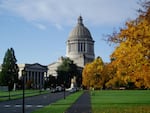
FILE - The Washington statehouse building in Olympia, Washington.
OPB
One of the most watched congressional races in the country is in Southwest Washington, and yesterday’s primary yielded few surprises.
Washington’s 3rd Congressional District will be critical for both Democrats and Republicans hoping to control the U.S. House. Of the 435 House seats on the ballot this year, it’s one of only a handful of races political experts say will be a toss-up.
Republican state Sen. John Braun and Democratic U.S. Rep. Marie Gluesenkamp Perez will face each other in the November election.
We get an update on that race from OPB’s Southwest Washington Bureau Chief Erik Neumann, and also hear about the Washington Supreme Court, Clark County Council and several sheriff elections from OPB reporter Elena Neale-Sacks.
Note: The following transcript was transcribed using AI and validated for accuracy, readability and formatting by an OPB volunteer.
Dave Miller: This is Think Out Loud on OPB, I’m Dave Miller. We start today with some of the results from Washington’s primary. In a few minutes, we’ll hear about the Clark County Council, where a majority of seats are up for grabs. First, we turn to the race for Washington’s 3rd Congressional District. This is one of the few true swing districts in the country. It has switched parties three times since 2010. The moderate Democrat Marie Gluesenkamp Perez has held it for the last two terms, winning her first reelection in 2024, even as the district went for Donald Trump. In the top two primary this year, she faced challenges from the right and the left. She and Republican John Braun got the most votes and will face off in November.
Erik Neumann is OPB’s Southwest Washington bureau chief. He joins us now with more details. It’s great to have you back on the show.
Erik Neumann: Thanks for having me.
Miller: So as I just mentioned, Marie Gluesenkamp Perez saw challenges from the left and the right. Let’s turn to the right first. State Senate Minority Leader John Braun, a Republican, was her challenger and will face her in November. What did he emphasize in this primary?
Neumann: Senator Braun is really sort of a moderate conservative. A lot of the things that he talked about during this race and historically have been along the affordability talking points that we’re hearing so much about all over the country right now. He’s sort of a classic fiscal conservative. When I asked him what he would approach at the federal level if he were to be elected, he described things like keeping the federal income tax rate low, going for an all-of-the-above energy strategy to try to lower the cost of products for small businesses and consumers to make life easier for them financially.
He said he agreed largely with the policies of the Trump administration. I think the one topic that he said he did not agree on was the use of tariffs for economic policy. He has a large business in Centralia where they make ambulances, and he said that his business had been affected by the tariffs on aluminum. Overall, a pretty conventional, moderate, fiscal conservative.
Miller: What about progressive Democrat Brent Hennrich? What did he focus on in this race?
Neumann: Hennrich talked about universal health care, the soaring cost of health care and the need to reintroduce subsidies. He advocated for taxing the rich. He’s talked about the need to restart some of the big infrastructure projects that were begun under the Biden administration. And then, as well as some of the things that he talked about prioritizing, he also was extremely critical of Gluesenkamp Perez. So oftentimes, when he was talking about the race, he would comment on her support for Israel, arguing that she didn’t protect voting rights sufficiently, and that she had supported different funding bills relating to ICE and immigration or defense funding at the federal level.
Miller: We’re still waiting for the next dump of vote results, but as they stand right now, Republican John Braun and Democrat Marie Gluesenkamp Perez are neck and neck at about 39% each, well above progressive Democrat Brent Hennrich who has about 15% – meaning there are a lot of votes up for grabs in the general election in November. So one of the big questions is how many of Hennrich’s voters will go for Gluesenkamp Perez, as opposed to maybe just sitting out, not being interested in a moderate Democrat. What did you hear about this in your reporting?
Neumann: Yeah, I think that’s one of the big questions. I heard that posed from both Republicans and Democrats who are not directly in the race. I went to an event in Vancouver last night that Brent had organized that was an election night party for Democrats. When I asked him this question, he basically said, “Don’t just give your vote away if you don’t believe in the things that this other candidate is saying,” that Gluesenkamp Perez should earn the vote from his supporters. He talked about how his race was not intended to just shift the politics of another candidate. He was in it to win.
So I think that is a big question of whether and how Gluesenkamp Perez will reconsolidate the Democratic group of voters, and whether or not Hennrich’s supporters are willing to shift to support her.
Miller: Do you have a sense for how much support the two candidates are gonna get from the national parties, Braun and Gluesenkamp Perez? How big a priority is this seat for the two parties?
Neumann: From what I’ve heard from talking to strategists, academics and things like that, it’s a huge priority for both parties. For anybody who’s watched TV recently, the ads are pretty much nonstop for both candidates. According to the Cook Political Report, it’s one of 18 truly toss-up seats around the country.
And there are lots of different variables right now. This is an off-year primary election, so we’re dealing with a pretty small group of voters who have actually come out. The difference between the two candidates was 0.2% right now, between Gluesenkamp Perez and Braun. There’s gonna be a ton of pressure on those voters to help decide.
Miller: Erik, thanks very much.
Neumann: Thank you.
Miller: Erik Neumann is OPB’s Southwest Washington bureau chief.
Elena Neale-Sacks joins us now. They’re the Southwest Washington reporter for OPB. Elena, let’s turn to some other election news. What happened with the Clark County Council?
Elena Neale-Sacks: So on the council there are three out of five seats up for election this year. All of them are contested, though one of the races in District 5 only has two candidates, so they’ll both advance to the general. In the District 1 and District 2 races, incumbents faced multiple challengers each. But at least according to these unofficial results, they both seem to have advanced out of their primaries. In District 1, the incumbent Glen Yung, who’s kind of a moderate voice on the council, he’ll likely face off against a brewery owner Bryan Shull, who is running on an anti-tax, limited government platform.
And then in District 2, the incumbent Michelle Belkot is poised to match up against a Vancouver middle school teacher, John Zingale. And Belkot has consistently voted against the rest of the council, especially on tax increases, which she opposes. So Zingale would be a very different councilor if he wins. He’s campaigned on more investment in county parks, reducing homelessness, and is more open to modest tax increases to fund those things.
Miller: What were the big issues in these elections?
Neale-Sacks: So there are a few key issues that framed these races. One of them, as I mentioned, was these issues of taxes, which come up a lot because Clark County’s been facing a persistent budget deficit, so people have different ideas for how to address that. Another one is where the county stands on support for plans to extend light rail as part of the I-5 bridge replacement project. And then another top issue is basically how best to accommodate a pretty rapid population growth in Clark County and build new housing.
Miller: How could the November results impact plans for balancing the county’s really rough looking budget?
Neale-Sacks: The results could play a big role depending on how things go. One thing that I haven’t mentioned, there’s an amendment on the ballot in November that voters will decide on, which would require a council supermajority, which would be four out of five council members, to increase local taxes. So if that passes, and Belkot and Shull win in November, or if the more tax-resistant District 5 candidate wins, then it could get much harder for the council to raise revenue, which has already been challenging. So that’s something that I’ll be watching for in November is basically what happens with that amendment, combined with who ends up winning these races.
Miller: What else are you going to be paying the most attention to in November with the races as they’re now shaping up?
Neale-Sacks: I am curious to see what happens in this District 5 race. That is the area that is more rural, northern Clark County. The current councilor decided not to run for reelection, so there are two candidates running. One is a more moderate, pragmatic, current Battle Ground council member who’s running on a more nonpartisan platform, and the other is very explicitly campaigning as a Republican. So that race, I think, could end up being a bit of a deciding factor for where the council goes.
Miller: Elena, thanks very much.
Neale-Sacks: Thank you.
Miller: Elena Neale-Sacks is OPB’s Southwest Washington reporter.
“Think Out Loud®” broadcasts live at noon every day and rebroadcasts at 8 p.m.
If you’d like to comment on any of the topics in this show or suggest a topic of your own, please get in touch with us on Facebook, send an email to thinkoutloud@opb.org, or you can leave a voicemail for us at 503-293-1983.