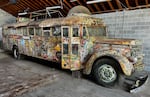
This undated, provided photo shows the 1939 school bus called Furthur parked inside a barn on the Kesey family farm in Pleasant Hill, Ore. For the first time since 1969, the bus that became a symbol of '60s counterculture will be on public display as part of a Grateful Dead-themed exhibition in San Francisco.
Courtesy of the Kesey Family
In 1964, Oregon author Ken Kesey and a group of friends, known as the Merry Pranksters, embarked on a cross-country road trip from California to New York aboard a 1939 customized school bus.
They painted the bus in psychedelic colors, added a rooftop platform and made other modifications. The bus, known as Furthur, became a symbol of the countercultural ethos of the ‘60s, from protesting the Vietnam War to ushering in the LSD-tinged anthems of the Grateful Dead in San Francisco.
And now, for the first time since 1969, Furthur has left its home at the Kesey family farm outside Eugene to open a new generation of hearts and minds.
As first reported by the New York Times earlier this month, the bus is returning to San Francisco as the centerpiece of “Forever Grateful, Golden Gate Park, a Grateful Dead-themed exhibition in San Francisco opening on Sep. 5.
The Oregon nonprofit Furthur Down the Road Foundation has been working for years to raise funds to restore the bus, which it hopes to start after the exhibit ends in late October.
Ken Kesey’s son, Zane, joins us to discuss Furthur’s legacy, the plans for its restoration and what lessons he thinks this countercultural icon can offer us today.
Note: The following transcript was transcribed using AI and validated for accuracy, readability and formatting by an OPB volunteer.
Dave Miller: This is Think Out Loud on OPB. I’m Dave Miller. In 1964, the Oregon author Ken Kesey and a group of folks known as the Merry Pranksters embarked on a cross-country road trip from California to New York. They took a 1939 school bus that they’d painted in bright swirling colors. Their trips, both literal and pharmaceutical, were immortalized in the book “The Electric Kool-Aid Acid Test.”
Then for more than 50 years, that bus, called Furthur, rusted and gathered moss back in Oregon. But it just hit the road again. It was put on a trailer and taken to San Francisco, where it’ll be the centerpiece of a new Grateful Dead-themed exhibition called “Forever Grateful.”
Ken Kesey’s son, Zane, joins us now to talk about the bus’s history and its future. It’s great to have you on Think Out Loud.
Zane Kesey: Thanks, Dave. It’s good to be here.
Miller: What is your first memory of the bus?
Kesey: Oh, painting on it. The day we got it, we’re painting it up. I was only like 3 years old and had blue paint in my hair. But it seemed like the thing every kid wants to do is go and paint on a vehicle.
Miller: What were paint parties like?
Kesey: They were painting it pretty quick to get it on the road and fixing it up. But it was mostly just put your paint on wherever you felt it.
Miller: And a 3-year-old was given free reign?
Kesey: Oh, yeah. Yeah, I was in with both feet.
Miller: For people who aren’t familiar with this history, can you give us a sense for that first cross-country expedition in 1964? You weren’t on it, but what did it entail?
Kesey: I was on it a little bit. But it was them making a movie, going across the country with a psychedelic bus and psychedelics that were, then, fairly unknown and still legal. The movie and the colorful outfits were kind of a way for them to get away with doing this. Whenever they’d get pulled over, they’d just pull out the cameras and start acting weird. And it looked like this is a circus and let’s just move them on to a different state.
Miller: Have it be somebody else’s problem?
Kesey: Yeah.
Miller: What does it feel like for you to be in the presence of the bus? I mean, it’s been on your property for more than 50 years. I’m curious what the bus feels like to you?
Kesey: It does have a presence, and it’s got energy. You can feel it. I’m excited for people to share it, and I’m really excited to try and preserve it. I’ve been saddened that it’s deteriorating. It would be gone beyond hope by now if it had stayed out in the forest that we called The Swamp.
Miller: At a certain point you brought it and put it in a barn, where it was a little bit safe from the elements, right?
Kesey: Yes, and I started fundraising to try and have it restored.
Miller: Do you have a favorite part of the bus?
Kesey: Well, the front end is always my favorite, but there’s nothing like riding on top.
Miller: You rode on top of the bus?
Kesey: Yeah, even during that original 1964 trip, they left us kids with our grandparents in Springfield, and met back up with Neal Cassidy, and went to the coast and drove down the coast roads. If you’ve ever been on top of a bus going around a corner, it really leans. [Laughter] With Cassady driving, going around the corners along those cliffs on the highway, I definitely remember that.
Miller: I’m glad you’re still with us. So you just had to hold on for dear life as a 3- or 4-year-old on [Hwy] 101 as Neal Cassady would drive this bus down those curvy roads?
Kesey: Yeah, definitely something you don’t forget. [Laughter]
Miller: When’s the last time the bus was actually driven, as opposed to carried?
Kesey: I’m pretty sure it was that trip to Woodstock. They had some stops along the way, on the way home, but I think that’s the last time it really went anywhere.
Miller: Then it was driven back from upstate New York and driven to Oregon?
Kesey: Yeah.
Miller: It’s worth saying again, obviously that was 1969. Even at that point, the bus was old. As I mentioned, this is a 1939 bus. So did it feel like an antique, even at the time?
Kesey: Yeah, people walking on top of it was one of the main functions of the bus. They were walking right on the actual body, which would pop the rivets. The body’s hollow, so the water would collect above the windows. And even in all the pictures of it at Woodstock, you can see that they had tried to fix all the rust with some fiberglass along there.
Miller: The Smithsonian noted that decades ago, when the bus was sitting in that field that you called The Swamp on your property – “moldering” is a term that they used – a family of foxes occupied the rear seat. Do you have a sense for what kinds of creatures have made their home in the bus over the years?
Kesey: Definitely some rodents. There were sleeping bags, rugs and all kinds of things in there because people would like to camp out and spend the night in there. But once it got really wet, that became extremely nasty. We pulled out two or three dump truck loads of stuff out of the bus, getting it ready to go.
Miller: So years ago, when your father’s alive, he turned down a request from the Smithsonian, as I understand it, to have the bus enter their permanent archive. How did you all decide that now was the right time to say goodbye to it at least temporarily, maybe permanently, and have it displayed at this exhibition in San Francisco?
Kesey: Well, the reason Dad turned it down for the Smithsonian is because they told him that they would never have room to display it, and that it could only be in their storage. And the way he put it is he didn’t want it to be stored away in a box next to the Ark of the Covenant.
Miller: Like “Raiders of the Lost Ark?”
Kesey: Yeah.
Miller: The display that’s gonna open next month in San Francisco’s Golden Gate Park, it’s different. This means the public will actually be able to see the bus?
Kesey: Yes.
Miller: I’m curious what your longer term hopes for the bus are?
Kesey: We’ve teamed up with the Haight Street Art Center. They’re hoping to create some permanent display, counterculture, psychedelic-era museum down there. And they want to help us with the restoration. We’ve already raised quite a bit of money, but not nearly enough. When it comes down to it, I’m hoping that we can get rid of the rust and save as much of the metal and anything else that we can. Just replacing body parts would be cheap and easy, but then you’d have a different bus. So I’m really hoping that we can save as much as we can.
Miller: This gets to almost philosophical questions about preservation, versus refurbishment, versus fully spiffing it up to make it look like it did, say, in 1964. Can you, first of all, maybe just give us your estimate for how many layers of paint there are on the bus right now?
Kesey: [Laughs] We’ve been finding out over the years, as [layers] slowly fall off. Each time chunks of paint fall off, the layer underneath is bright and colorful again. But now, we’re getting down to original school bus yellow and mostly rust.
Miller: So from the pictures, it really does seem like you can feel the history on this bus, maybe more so than if it were cleaned up and given a vibrant fresh coat of bright paint. Does any part of you just want to have somebody throw a bunch of clear varnish on it to somehow stop the rust, but preserve it, in a sense, in amber?
Kesey: Yeah, I’ve thought about that a lot. If there were a way to stop the rust that’s deep inside of the metal, I would totally do that.
Miller: But that might be too hard. So in the end, where are you leaning? What do you want this to look like? We’ll get to the money part in a second. But setting aside the money, what do you want people to see, say five years from now, if this is on permanent display in some museum of counterculture in San Francisco?
Kesey: Well, there’s a lot of options for how it looks – looking just like it is now or just like it was in its heyday, and everything in between. But mostly I care about making it last and keeping the energy there, making sure that when it’s restored, it still has that feel. Everything else is just aesthetics.
Miller: What have you been doing over the years to try to raise money to refurbish the bus?
Kesey: We’ve been doing a lot of auctions online. Right now, we found parts of Cassady’s seat leather, and we’ve cut it up into little chunks and are selling little authenticated pieces of Cassady’s seat leather on Facebook. People have been donating stuff. Stanley Mouse and Mike DuBois have been donating Grateful Dead posters to auction. There’s been a groundswell of just grassroots sales and donations. But now we might have the big boys helping out.
Miller: The big boys? My understanding is you’ve raised a couple hundred thousand dollars through those sort of smaller-scale efforts. Do you have a ballpark figure for how much it’s gonna cost to get the bus in the kind of shape you’re hoping for?
Kesey: I’ve seen wildly different estimates, going from almost what we have now to a couple million, depending on what you’re doing and how much metal you’re saving. So I’m assuming it’s going to be somewhere in the middle. I’m just trying to push as hard as possible to save as much metal and original bus as possible.
Miller: I guess this gets us back to what we were talking about earlier, the spirit that you feel, the presence you feel from this bus. What message do you think this bus has for people in 2026?
Kesey: That love is fun. The good old spirit of the ‘60s is exciting and vibrant, and should still be giving you a hug like it did back then. We need it now.
Miller: That love is fun. What was it like after 50+ years of having this bus be near you, on your property, to have it be loaded up in a trailer and rolled hundreds of miles away from your home?
Kesey: It’s the first time that I can remember that I’ve been away from it, but I’m OK with it. I know that it’s in good hands. It’s the first time I’ve really felt solid hope, not just trying to roll a rock up a hill, gathering funds here and there. I’m really excited.
Miller: Zane Kesey, thanks very much.
Kesey: Thank you.
Miller: Zane Kesey is Ken Kesey’s son. He joined us to talk about the past and the future of the famous bus ridden by Ken Kesey and the Merry Pranksters.
“Think Out Loud®” broadcasts live at noon every day and rebroadcasts at 8 p.m.
If you’d like to comment on any of the topics in this show or suggest a topic of your own, please get in touch with us on Facebook, send an email to thinkoutloud@opb.org, or you can leave a voicemail for us at 503-293-1983.