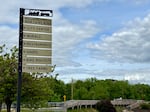
A cloudy afternoon in the city of North Plains on May 19, 2026. The Washington County town has fewer than 4,000 residents, and people inside and outside the city limits have been sharply divided over expanding the urban growth boundary. The rancor over differences of opinion about whether and how to plan for growth has spurred massive turnover in city government in the last two years.
Allison Frost / OPB
Residents in the Washington County city of North Plains have been sharply divided for years over whether and how much to expand its urban growth boundary. City leaders passed a plan in 2024 that was overturned in a popular vote and in the same election ushered in a new anti-growth majority on the council. In less than 2 years, the majority of those councilors have resigned, along with the mayor and two subsequent replacement mayors.
North Plains also saw the departure of its city manager and had two interim city managers resign one after the other. The current interim has a contract that expires on Sept. 1.
In June we went to North Plains to talk to people inside and outside of the city limits to hear about their different ideas about growth and maintaining their rural identity — and the other issues fueling the turnover in local government.
Austin De Dios is a politics reporter focused on Washington and Clackamas counties for The Oregonian/Oregonlive, and he joins us to share the latest on the community and city government of North Plains.
Note: The following transcript was transcribed using AI and validated for accuracy, readability and formatting by an OPB volunteer.
Dave Miller: From the Gert Boyle Studio at OPB, this is Think Out Loud. I’m Dave Miller. Residents in the city of North Plains in Washington County have been sharply divided for years over whether or how much to expand their urban growth boundary. City leaders passed a plan in 2024 that was overturned in a popular vote.
We talked about this in a show in front of an audience in North Plains in June, but a lot has happened since then. The city manager departed, along with an interim city manager. The appointed mayor resigned as well. So did two of our guests on that show, the director of libraries and the assistant city planner. Now there is a recall effort underway to remove one of the remaining elected members of the city council.
Given all of this tumult and turnover, we thought it was a good time to check in on North Plains once again. Austin De Dios joins us now. He’s a politics reporter at The Oregonian focused on Washington and Clackamas counties. Austin, it’s good to have you on the show.
Austin De Dios: Thanks for having me, appreciate it.
Miller: For people who missed our conversation back in June, can you remind us the basics of what set up this current crisis a few years ago?
De Dios: Yeah, absolutely. I would say that the current crisis started about this argument about growth, about how the city should grow and how it should expand its urban growth boundary. So there have been multiple attempts to add small increments to the urban growth boundary, which, for the most part, voters had turned down. And in 2023, the city council had decided to move forward with a large proposed expansion that would add 855 acres to the urban growth boundary. I think that would over double the size of the city currently. But in 2024, that went to the ballot, voters turned it down. The state tried to intervene but was unsuccessful. That plan fell flat.
I think that argument is still ongoing. There’s still this continued conversation about how the city should grow, this battle between maintaining the North Plains’ rural character versus economic growth and being able to expand. The city has made the argument, in some cases, that expanding the urban growth boundary would allow them to add more city services because they’d have more tax revenue. But people are trying to move forward, especially residents who want to see growth done in a smart and incremental way.
Miller: There had already been a ton of resignations in recent years before our show just two months ago. But as I mentioned in my intro, there’s been a flood of them since then, including the city manager and the interim city manager after him. In the case of the interim one, Gary Marks, He stuck around for one week, I think it was. How did he explain his decision to step down?
De Dios: Essentially, he blamed the departure of nearly every department director and the lack of support as his reason for stepping down. He said there was no real way to successfully understand how the city ticks without having that institutional knowledge which was lost with all that turnover. I think his exact words were: “Given the past departures of nearly every department director, coupled with a lack of any meaningful administrative support, there was no way to successfully understand city processes and systems.”
Miller: What did one of the former mayors, Aaron Dumbrow, say recently when he stepped down?
De Dios: His resignation was interesting. He wrote in his resignation letter that he couldn’t really continue working with his fellow city councilors. He alluded to a lot of that attrition and infighting. But he also said, direct quote from him, “As a person of integrity, I cannot continue to lead the city based on numerous legal and council rule violations by the previous and current council.” He didn’t give any more details beyond that, but it seemed like that was a large reason for his departure.
Miller: Is it fair to say that what started as a protest against plans to expand the urban growth boundary has sort of expanded to be a kind of crisis about the governance of a city where there’s a lot of mistrust?
De Dios: I think it’s nuanced, but I think it’s definitely developed and maybe is also devolving as we see a lot more infighting, and also just concerns. Recently, the acting mayor and city council president, Mandy Hagedorn, stepped down. In her resignation letter, she said a lot of that reason was fear for her own personal safety. She didn’t say exactly why or share any specific details, but she said outside interest groups, she alleged that they had been harassing her. And that’s not uncommon, two other city councilors have raised similar concerns. So I think that is definitely becoming an issue, and we’re seeing a lot of residents who don’t trust the city government to help the city move forward in a healthy and helpful way.
Miller: Well, given these sort of vacuums in city leadership with all these departures, where does city governance stand? How is this affecting North Plains residents?
De Dios: When there was the initial rush of resignations, Gary Marks and Aaron Dumbrow, the city did temporarily have to shut down its public services building. That didn’t last very long, and in fact, city councilors actually came to volunteer and fill shifts there so they could keep the building open.
Other than that, I think what we’re seeing most is a stall in the city being able to move forward on a lot of the projects and daily city functions that they are responsible for moving forward. I’m thinking a lot of these committees and commissions that the city is responsible for hearing from who haven’t had meetings in weeks, in some cases months, because the city council has not been stable enough to be able to support them, and so they haven’t been meeting to move things forward.
I think also, conversations about the urban growth boundary have stalled as well because the city council is in such turbulence that they haven’t been able to really take a close look and move forward with that yet.
Miller: You’ve reported the city has also been late in turning in required financial audits to the state. Where does that stand right now?
De Dios: They recently finished their audit for 2022.
Miller: 2022?
De Dios: 2022. The last audit they had finished was in 2023 for 2021. [The 2022] audit found several deficiencies in their accounting processes. Nothing outwardly negative, but there are lots of ways that the journals were being done and records were being kept that the auditing firm was not super happy with. So they gave some recommendations. However, a lot of those recommendations are the same ones they got in 2021, because there was that gap where they couldn’t really implement a lot of these changes because they had done the 2021 audit in 2023, which is beyond 2022. So none of the changes could come into effect.
City officials had said that they expect future audits to look better, that they have been able to implement some better financial accounting practices that will help moving forward. They estimate they’ll be done and caught up with the state’s requirements for yearly audits in 2028 at the current pace they’re at.
Miller: Meanwhile, you’ve been reporting that the departures may not be over. Earlier this month, residents filed prospective recall petitions against the last two elected members of the city leadership, council president and acting mayor Mandy Hagedorn, and Councilor Mark De Forge. You just mentioned that Mandy Hagedorn is stepping down, but where does the recall effort against the councilor Mark De Forge stand?
De Dios: So that is still an ongoing process. The petitioners wanted to have some sort of progress reported in September. They technically, I believe under state law, have 90 days to gather the correct number of signatures. I think that’s a little over 240 signatures that they need per petition. Although, of course, now it’s only Councilor De Forge who is up for a potential recall. If they get the number of signatures in that amount of time, it’ll go to the ballot and voters will decide. And De Forge was appointed, so I guess we’ll see where that moves forward. But in his remarks regarding that particular recall petition, he said he’s tried his best to serve the city as best he can, and now his fate’s in voters’ hands, if that’s what it comes to.
Miller: Austin, thanks very much.
De Dios: Yeah, of course. Thank you.
Miller: Austin De Dios is a politics reporter at The Oregonian focused on Washington and Clackamas counties.
“Think Out Loud®” broadcasts live at noon every day and rebroadcasts at 8 p.m.
If you’d like to comment on any of the topics in this show or suggest a topic of your own, please get in touch with us on Facebook, send an email to thinkoutloud@opb.org, or you can leave a voicemail for us at 503-293-1983.