A judge has sided with Oregon’s new statewide recycling system in a lawsuit brought by distributors.
The National Association of Wholesaler-Distributors sued state officials in 2025. They criticized Oregon’s law requiring them to pay fees based on the packaging they use to distribute products — like beverages, building supplies and medical supplies — to other businesses.
Those fees help pay for standardizing Oregon’s recycling standards and expanding recycling services to more communities. The distributors association argued the law was unconstitutional.
After a five-day bench trial, U.S. District Judge Michael Simon sided with Leah Feldon, director of the Oregon Department of Environmental Quality, who was named in the lawsuit. Simon ruled that Oregon’s Plastic Pollution and Recycling Modernization Act didn’t violate commerce clauses in the U.S. Constitution.
“Oregon has long been a national leader in waste prevention and recycling, and we’re pleased that the court has recognized the state’s authority to move forward with a modern recycling system that works for Oregonians,” said Jen Parrott, DEQ administrator of land quality programs.
The National Association of Wholesaler-Distributors is made up of 30,000 businesses representing the $8.6 trillion wholesale distribution industry. They range from mid-sized companies to publicly-traded corporations that rank among the Fortune 100. The association is challenging similar recycling laws in California and Colorado.
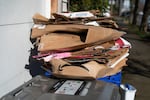
FILE: Cardboard packaging sits in a stack on top of a recycling bin outside a garage in Portland in 2026. Oregon lawmakers enacted a recycling system that shifts costs onto corporations, so they pay for the product packaging they bring to Oregon.
Eli Imadali / OPB
In court documents, the distributors association called Oregon’s recycling system a “labyrinthine scheme, shrouded in secrecy,” that imposes fees on businesses that have little control over the rates they pay.
They also argued the law discriminates against out-of-state businesses. In one example, the association noted exemptions for Oregon state, local and special government bodies, including Oregon public universities.
Those in-state agencies don’t need to pay product packaging fees, even when they sell branded merchandise. Out-of-state schools like Washington State University don’t have the same exemption.
The law also exempts small businesses with gross revenues under $5 million. The association argued this discriminates against companies with operations in multiple states. They presented an example: A $1 million-company solely with operations in Oregon would be exempt, but a company with $1 million-worth of operations in Oregon — in addition to other operations in other states — might still have to pay fees.
Still, the judge found no evidence supporting their arguments. Simon wrote that by enacting the recycling law, “Oregon is exercising two fundamental police powers: mitigating waste pollution and protecting the health and safety of its citizenry.”
The ruling lifts a preliminary injunction that temporarily halted packaging payment requirements from the association’s members. If a business fails to pay its required fees, it could face fees ranging from $375 to $3,000 a day.
“While we are disappointed with the outcome, we were prepared for it,” the association’s staff wrote in a press statement, adding that they are considering “options for next steps.”
If the association were to appeal Simon’s decision, it would bring the case to the U.S. Court of Appeals for the Ninth Circuit.
A handful of other states have passed similar recycling laws, but Oregon was the first to officially launch its recycling system and begin charging producers fees in 2025. Those fees are based on how much paper and other packaging a company produces.
For example, money might help a local hauling company purchase new trucks and recycling bins, while some funds would help local governments administer the program and educate people about how to recycle.
Wholesalers and distributors have to pay for any new packaging they add to the system. So, a distributor that delivers canned soda to grocery stores wouldn’t be charged for the cans the soda comes in, but it could be charged for pallets it uses to deliver canned soda and then disposed of afterward.
In 2025, distributors’ invoiced fees made up less than 5% of all producer fees in Oregon, according to DEQ’s court filings.