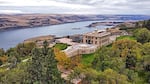
The Maryhill Museum of Art in Goldendale, Wash., overlooks the Columbia River Gorge in this undated, provided photo. On Sept. 19, 2026, admission to the museum is free with a program of activities celebrating its centennial anniversary.
Courtesy Maryhill Museum of Art
On Saturday, the Maryhill Museum of Art in Goldendale, Washington, will celebrate its centennial anniversary with free admission and activities honoring the museum’s unique history and identity.
Perched on a bluff overlooking the Columbia Gorge, visitors can explore the museum’s many collections that include Indigenous baskets and beadwork, sculptures by Auguste Rodin and hundreds of chess sets from around the world. The museum’s sprawling grounds boast a full-scale replica of Stonehenge and sculptures made by Pacific Northwest artists.
The day’s festivities also include Romanian folk dancing and music as a tribute to Queen Marie of Romania’s visit to the site 100 years ago to dedicate the museum co-founded by her friend and entrepreneur, Sam Hill. Three current exhibits showcase the museum’s cultural ties to Romania, including new displays of Romanian pottery and embroidered textiles.
Amy Behrens is the executive director and CEO of the Maryhill Museum of Art. Michael Oros is the master of ceremonies for Saturday’s events, president of the Romanian American Society and a member of the museum’s board of trustees. They join us to preview Saturday’s program and the special exhibits celebrating the museum’s history.
Note: The following transcript was transcribed digitally and validated for accuracy, readability and formatting by an OPB volunteer.
Dave Miller: This is Think Out Loud on OPB. I’m Dave Miller. The Maryhill Museum of Art in Goldendale, Washington, is celebrating its centennial anniversary tomorrow. The museum, which is perched on a bluff overlooking the Columbia Gorge, will have free admission and activities honoring its unique history and identity. That includes a big focus on Romanian culture because 100 years ago, Queen Marie of Romania came to the site to take part in the dedication of the new museum.
Amy Behrens is the executive director and CEO of the museum. Michael Oros will be the master of ceremonies for tomorrow’s events. He is the president of the Romanian American Society and he’s a member of the museum’s board of trustees. Welcome to you both.
Amy Behrens: Thank you. Glad to be here.
Michael Oros: Thank you for having us on, Dave.
Miller: Amy first, can you describe the dedication ceremony that happened 100 years ago?
Behrens: Yes, 100 years ago, Queen Marie made a highly publicized train trip across the United States. She arrived at the Maryhill Museum of Art on November 3, 1926, in which was as yet an unfinished museum. But she dedicated it in front of a crowd of 2,000 people – and mind you this was before the construction of the freeway – saying, there is a dream built into this place, a dream for today, but especially for tomorrow.
Miller: Michael, who was Queen Marie?
Oros: Queen Marie was an exceptional person. I really refer to her as a trailblazer for her time, a word very much close to the heart of Oregonians in this part of the Pacific Northwest. She was beloved by Romanians, but she was very much known in the entirety of Europe given her active role in Queen Victoria’s court and being a seated queen herself. She was on the front in WWI and then she was on the front of the peace treaties in Paris after WWI, helping to ensure that Romania was represented, treated fairly and had a role in the world moving forward.
Miller: Why was the Queen of Romania interested in helping to create an art museum in a rural part of the Pacific Northwest, I mean, across an ocean and then across a continent?
[Laughter]
Oros: Fantastic question. As I mentioned, Queen Marie was at the great Peace Conference in Paris where she met the great businessman that has built the museum, Sam Hill. And through that connection in Paris, he continued to help Romania after WWI. The Queen wanted to recognize that and pay tribute to his efforts by visiting the U.S., furthering the diplomatic relationship of a newly-formed Romania – which in its current form, was in 1918, so a young country – diplomatically establishing the relationships between the two countries. But [she also [paid] homage to Sam Hill as well and that friendship, and how much he helped Romania by dedicating the museum, bringing over 70 pieces that she donated, personal items, to the museum and many more after that as well.
Miller: What are some of those pieces that she brought with her? Amy?
Behrens: Among the works that Queen Marie brought to the museum were especially handwork, pieces of handwork: Romanian embroidery, Romanian folk pottery and Orthodox icons. Examples of these types of objects, that can all be seen on exhibition at Maryhill Museum of Art right now.
Miller: So, the dedication ceremony that we’re talking about, that was November of 1926. But from my understanding, it was 14 years. It wasn’t until 1940 that the museum opened to the public. Why that long gap?
Behrens: Well, when Sam Hill passed away in 1931, his estate went into probate, and both Loïe Fuller and Queen Marie died later that decade. And so Maryhill had a long journey from idea to reality. Ultimately, Alma de Bretteville Spreckels, the fourth museum co-founder, carried the vision forward, and she formed Maryhill’s founding board of trustees in 1938 and hired its first director. The museum finally opened on May 13, 1940, which was Sam Hill’s birthday.
Miller: It’s fascinating to think about a museum opening in 1942. World War II is raging. The U.S. is going to enter it soon, but the world is at war and this museum is born.
Behrens: That’s right.
Miller: Michael, what can people expect tomorrow? What are the festivities?
Oros: The festivities are going to be fantastic. We have local performers. I’ve explicitly selected performers from Seattle and the Portland area that will be delighting those attending with Romanian dances and music, including traditional Romanian food. But in other aspects really, we are really trying to bring the 1926 event to life, and we are having some historical cars from the 1920s being brought up. If you’re up early in the morning tomorrow on I-84, you might see a couple of them driving to the museum. And we’ve asked all the Romanians in the area who have their national costumes to come dressed in their national costumes. This is like bringing the collection that Queen Marie has bestowed to the museum and others that we’ve added to the collection since, bringing it to life through the museum and the museum property outside while we’re celebrating.
Miller: I mentioned, Michael, that you are both the president of the Romanian American Society and also a member of the trustees for the museum. How much of your interest in the museum is connected to your Romanian heritage?
Oros: Tremendously. I moved to the U.S. with my family to Oregon in 1990. And in that summer, we took a trip across the U.S. to get to know this beautiful country – all the way to Niagara Falls and then back to Oregon, almost mirroring the Queen Marie trip by train. But we did it by car and in reverse order.
But on the way back, I noticed we’re almost to Portland, and I noticed this building across the river on the bluff. I was called out to it. And I asked my dad, I was like, “Hey, can we cross over and go see what’s there?” And to my great surprise, finding out this beautiful place and connection to Romania that I was not aware of, it was not something that was included in the history that I was taught in [Romania] – granted, I left in sixth grade from Romania. We did not know. We weren’t taught about this great trip and what the Queen planted, this cultural seed, so far, nearly on the opposite side of the world from Romania.
In that day, I found it thriving. And it called out to me. I continue to stay involved with the museum throughout, joining its board 15 years ago, and getting more and more involved with it, and keeping that active connection with Romania and the community alive.
Miller: Amy, you’ve been the executive director for a little over three years now. What do you remember about the first time that you saw the museum?
Behrens: I was just completely taken with it. First, there’s that gorgeous drive through the Gorge, and then you arrive and you discover this extraordinary museum in a place you don’t expect it. I remember being astonished by the Rodin collection and the Indigenous beadwork. I grew up in California with access to some wonderful museums, and I remember thinking, how did I not know this was here?
Miller: What do you think makes the Maryhill Museum of Art unique?
Behrens: Well, there are so many things. It was unexpected from the beginning. Its story grew from international friendships that believed in the power of great art surrounded by the beauty of nature; and they believed that such a museum had more advantages than disadvantages, if only there would be people that had the same conviction to support it. And that’s why I think it’s magnificent that we’re celebrating 100 years today. Maryhill is 100, but it continues to evolve, and it gives people new reasons to return.
Miller: Could you tell us about one of the permanent collections in the museum which is based on some miniature French fashion?
Behrens: Oh, wonderful, I’d love to. I think you’re referring to our Théâtre de la Mode
fashion collection. It’s one of eight distinct fashion collections at Maryhill Museum of Art. And this collection of miniature mannequins is truly a story of resilience created by the Parisian couturiers in 1945 and 1946. Maryhill Museum of Art is home to nine of 12 of the 1946 collection that toured across the United States to raise war relief funds for France after World War II.
Miller: And my understanding is that every year or so, different pieces of the collection are shown.
Behrens: We typically rotate three of the decors every other year.
Miller: What are the exhibitions that are currently on display for the centennial? What can people expect?
Behrens: There are three exhibitions that are referencing or giving different windows into Romanian culture and especially Romanian culture that was brought by Queen Marie as part of her gifts to the museum, when she dedicated it in 1986: Romanian embroidery, Romanian folk pottery and Russian icons or Orthodox icons with New Mexican Bultos and Retablos. There are ways to encounter her relationship throughout the museum at any time this year, not just during Saturday’s celebration.
Miller: Wait, does that mean that one of the exhibits has Christian art from Russia and from New Mexico mixed in together?
Behrens: [Laughs] That’s right. Well, Marie brought with her several Orthodox icons, when she dedicated the museum in 1926. The museum’s ecclesiastical art collection grew from those initial gifts and now includes Catholic ecclesiastical art. And this year we’ve exhibited five of the Orthodox icons that were created – these were created in Russia – that Queen Marie brought with her to the 1926 dedication alongside Bultos and Retablos from New Mexican santeros, or religious imagery makers.
Miller: Michael, how do you think the setting in the Gorge has shaped the museum itself?
Oros: It really has a royal setting. Being surrounded by mountains that are crowned with snow almost year-round, gives it that majestic feeling, and the visual beauty of the Gorge driving in is just inspiring. And the physical place has really made a connection to the people, a bridge between cultures.
One of my fondest memories is being there at the 80th anniversary of the museum’s dedication and seeing an interesting older gentleman resting against the side of the museum. I felt he had a story, so I introduced myself and found out he was one of the children. The schools were closed on the dedication day, and all the children were brought up to the museum on that day, and he was one of the kids that day. The event made a profound impact that affected him throughout his entire life.
I’m hoping this event today and tomorrow will really put that same feeling forward into the hearts of the kids that’ll be running around at the festival tomorrow and that they’ll remember us in 100 years at the museum’s 200-year anniversary.
Miller: Well, Michael and Amy, congratulations and thanks very much.
Behrens: Thank you so much for having us. I hope you can attend the centennial celebration tomorrow.
Miller: Amy Behrens is the executive director and CEO of the Maryhill Museum of Art. Michael Oros is a member of the board of trustees for the museum. He is the president of the Romanian American Society. They joined us to talk about the 100th anniversary of the dedication of the Maryhill Museum in Goldendale. There’s gonna be a celebration again at the museum tomorrow.
“Think Out Loud®” broadcasts live at noon every day and rebroadcasts at 8 p.m.
If you’d like to comment on any of the topics in this show or suggest a topic of your own, please get in touch with us on Facebook, send an email to thinkoutloud@opb.org, or you can leave a voicemail for us at 503-293-1983.