
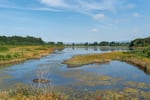
A small section of the Ridgefield National Wildlife Refuge in Ridgefield, Wash., on Aug. 19, 2026. Thousands of people have signed a petition opposing development in an open field next to the refuge.
Saj Sundaram / OPB
When Jim Maul crosses a bridge along a trail into the Ridgefield National Wildlife Refuge, it’s like entering another world.
Nearly 200 bird species and dozens of mammals, reptiles and amphibians dot the more than 5,000 acres of protected marshes, grasslands, and forests along the Columbia River, right next to one of Washington’s fastest-growing cities.
Maul helps lead a nonprofit to support the refuge. On a recent morning stroll, he pauses as he rounds the first bend in the trail. To his left, through the trees, is Carty Lake — where glassy water attracts countless migratory birds each fall.
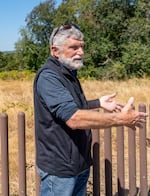
Jim Maul, co-board president of the Friends of Ridgefield National Wildlife Refuge, a nonprofit supporting the refuge.
Saj Sundaram / OPB
“You can hear the joy in their voices at having reached this destination,” Maul says.
The lake, he adds, is an essential rest stop for birds journeying thousands of miles.
On its far shore lies a property line separating federal land from 40 acres owned by the Port of Ridgefield. Right now, both sites offer open space, wildlife habitat and serenity.
But while the refuge has been closed off to development for the last 60 years, this neighboring waterfront property — which has helped attract many people to Ridgefield in recent years — could soon become the site of multi-story apartments, a boutique hotel, restaurants and shops.
“Windows, lights, around the clock activity could have a tremendously detrimental effect on the wildlife,” Maul says.
As the co-president of the Friends of Ridgefield National Wildlife Refuge, he is a leader among a growing number of residents worried about what the development could mean for the birds that depend on the refuge.
More than 4,100 people have signed a petition opposing the plans, many of them focused on the refuge, with others critical of how the development could limit public access to waterways or change the character of the city.

Port staff say they’ve slowed down the first phase of what could be a multi-decade construction project to better understand these concerns and how to mitigate them.
But part of the Port’s mission is to spur economic development, and there’s strong demand for housing and more amenities in a booming city of about 17,000 residents, where the population has doubled in the last decade.
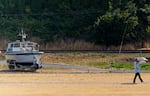
Maddy Bisila walks along a gravel path in the open field next to the Ridgefield National Wildlife Refuge, Aug. 19 2026.
Saj Sundaram / OPB
The waterfront was an abandoned mill site before the Port spent decades cleaning it up. The agency has been planning to turn the land into a mixed-use development for 25 years. It finally selected a developer for the project, Palindrome Properties Group, in 2024.
“Really, it’s creating a place where people want to live, work and play,” says Ethan Perry, the executive director of the Port.
Perry and his colleagues spent this summer on a community engagement campaign. They gave presentations, tabled at the farmers market, and drove people around the waterfront site in golf carts.
On a recent golf cart tour with OPB, Perry says some people have told him they’re excited about having a hotel so their relatives could have a place to stay when they visit.

Ethan Perry, executive director at the Port of Ridgefield.
Saj Sundaram / OPB
“We also hear from people who want to come down here and go to a restaurant or they want to have a glass of wine after work or go for a walk and have a burger and a beer,” he says.
Slowing the cart to a stop in front of a big empty field, he also acknowledges the criticisms.
“This is probably where we’ve gotten the most pushback,” he says, pointing to the site of what could become six three-story residential buildings, right next to the refuge.
Perry says the Port is rethinking its initial plans after hearing concerns about the potential impact on migratory birds.
The U.S. Fish and Wildlife Service designated the refuge in 1965 to protect winter habitat for the dusky subspecies of Canada geese.
The land used to be the site of a bustling Chinookan village and trade center called Cathlapotle, and local tribes continue to hold events and ceremonies here.
“It really just needs to be protected,” says Maul with the Friends of the Refuge.
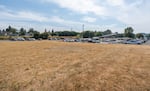
The the open field next to the Ridgefield National Wildlife Refuge, the site of what could become six three-story residential buildings.
Saj Sundaram / OPB
Beyond the birds, residents have other concerns. Traffic congestion is a big one. So is public access to the boat launch at the waterfront, which some residents argue won’t have enough parking under the Port’s current plans.
“The demand for that access has increased every year,” says Dion Hess, a longtime Ridgefield resident who uses the boat launch frequently during the salmon fishing season.
Rather than turn the waterfront into an economic engine, he wants the Port to protect people’s access to the Columbia River and limit negative impacts to the refuge.
He’s on board with the petition opposing the development organized by Ridgefield resident Wendy McIntire Gilbert.
“We’re not saying we’re anti-growth,” she says. “We understand there’s a need for these things. We just don’t feel it’s appropriate on the waterfront.”
McIntire Gilbert is often there enjoying the open space and the wildlife. Even when she’s not, she has enjoyed watching some of its most beloved visitors from afar — through a camera trained on an osprey nest.
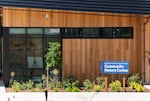
The Ridgefield National Wildlife Refuge’s community nature center where visitors can learn about the environment and wildlife along the Lake River tributary in Ridgefield, Wash.
Saj Sundaram / OPB
“The babies hatch every spring, and it’s really cool to see,” she said, “but the irony is that that camera is now going to be watching as they dig and bulldoze and build concrete in this area where these birds nest.”
Birds have become a big part of the city’s identity.
The official mascot for Ridgefield is Carty the Sandhill Crane — their image is stamped on the top of a letter the City Council recently sent to the Port Commission.
In the letter, the councilors thanked the Port for the decades of work it took to turn the old polluted mill site next to the refuge into open space people enjoy. But they also urged the Port to listen to the public’s concerns about what comes next for the waterfront.
“We believe the time is now to go from listening to reflecting to acting,” the councilors wrote. “We only get one chance to get this project right for generations to come.”
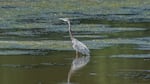
Plenty of wildlife can be seen on the banks of the Lake River tributary, located near the Ridgefield National Wildlife Refuge.
Saj Sundaram / OPB