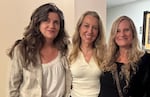
From left, Oregon authors Monica Drake, Cheryl Strayed and Lidia Yuknavitch pictured at OPB on Sept. 9, 2026, after being interviewed about "The Big M." The book is a collection of 13 essays about menopause, including stories by these three authors.
Geoff Norcross / OPB
Menopause is one of the biggest transitions women go through and, for some, the most difficult. For many, it’s a challenge to get medical care and other support during those years. That’s because research and education about menopause and perimenopause has been severely lacking, as well as the cultural space to center women’s experiences — particularly around menses, perimenopause and menopause.
Oregon author Lidia Yuknavitch aims to expand that space with a new book of essays she edited. “The Big M” is a collection by 13 different writers reflecting on their experiences of menopause and perimenopause. The book uses these distinct but unified perspectives to rebrand and reinvent our understanding of “the big change.”
Portland authors Cheryl Strayed and Monica Drake contributed their stories to the book. They join us, along with Yuknavitch, to discuss their essays and their perspectives about the cultural conversation about menopause.
Note: The following transcript was transcribed digitally and validated for accuracy, readability and formatting by an OPB volunteer.
Allison Frost: This is Think Out Loud. I’m Allison Frost. Menopause is one of the biggest transitions women go through, and for some, the most difficult. For many, it’s a challenge to get medical care and other support during those years. Research and education about this big change has been severely lacking, as well as the cultural space to center women’s experiences, particularly around menses, perimenopause and menopause.
Oregon author Lidia Yuknavitch aims to expand that space with a new book of essays she edited called “The Big M: 13 Writers Take Back the Story of Menopause.” It’s a collection from 13 different writers reflecting on their experiences with menopause and perimenopause. Portland authors Cheryl Strayed and Monica Drake contributed their stories to the book, and they all join us now. Lidia, Cheryl and Monica, welcome back to Think Out Loud.
Monica Drake: Thank you.
Cheryl Strayed: Thank you.
Lidia Yuknavitch: Thank you.
Frost: Well, starting with you, Lidia. The collection is grouped into three different sections. I was just wondering, did you think of that before, or did that kind of organically arise as you read what you got?
Yuknavitch: It organically arose for sure because the essays coming in started creating their own story space. And after about seven of them came in, that story space started having a shape and some themes, and some things were repeating and other things were completely different from the first three I received. So, I would say it was organic, and that it became a creature and it began to speak back.
Frost: How did you choose the writers you included? Who are they to you?
Yuknavitch: Well, they’re friends, dear friends, like the two women sitting with me here today, but also people whose work I already knew out there in the world was at some kind of intersection or cusp, idea wise and style wise. And then some came in that were suggestions from other writers. So then there was a little bit of a culling. I wanted to put 100 essays in and we weren’t allowed to put 100 essays in.
Frost: I think you’re supposed to be 300 pages or less, right? That’s the wisdom. Well, in this introduction, you have this great list of possible menopause symptoms, and of course by great I mean horrific. I’d love for you to read that, starting with the ever-popular hot flashes and some others that are not as well known: brain fog, sore breasts, anxiety, poor sleep.
Yuknavitch: And that list doesn’t even begin to cover the hundreds of other symptoms people who experience perimenopause and menopause share with each other. Let’s eyeball a bigger list. It’ll be OK. We’re looking at it together. The list isn’t going to kill us just from reading it.
Weight gain; gut and digestion hijinks; mood roller coasters; irregular bleeding, odd blood floods; weird sex drive fluctuations in all directions; dryness, itch and ache all up in the nethers. They call this vaginal atrophy, which is the worst name in the history of ever, so I’ve renamed it vaginal revolution. But seriously, I thought I had a cactus growing all up in there.
Headaches; fatigue; joint pain; odd tingles in your hands or feet; the bloats, digestive tricks; memory loss, or just the inability to remember what memory even is any longer, it goes away; thinning hair; brittle nails; dizziness and even fainting; jackknifing heartbeat; changes in body smells; changes in pee, all the time, not enough; sometimes an increase in UTIs. This happened to me rather dramatically.
Thinning uterus; rearrangement of internal organs; dropping. Don’t panic, it’s a thing.
And of course, depression, especially if someone is experiencing one or all of these altered states and has no one to share it with.
Frost: I love that list so much. We actually asked women about women’s experiences with menopause on Facebook, and a lot of women shared with us.
Stefanie Johnson Ulibarri wrote, “The brain fog and fatigue have been the worst parts for me. The weight gain isn’t appreciated either. I’m proud of my fellow Gen Xers who have helped force attention to this. Women shouldn’t have to suffer in silence as they have for millennia.”
Well, personally, the brain fog was one that I didn’t know was a symptom of menopause, partly because no one told me and I realized, in retrospect, it was the second year of the pandemic. So I was just wondering how common that is for all of you. Do you want to start, Monica?
Drake: Well, it’s hard for me to separate brain fog that’s due to menopause from really high-stress life situations. So I don’t really feel like I know. My piece says I was holding down a full-time teaching job, and also parenting and in divorce court. So I had definite brain fog, but I can’t really pinpoint the source. [laughter] It was a lot to carry.
Frost: And we are definitely going to get into the details of your story.
Drake: I think I probably could say yes, brain fog was a symptom, but it’s just like life is so complicated that it’s hard to identify what’s happening sometimes.
Frost: Absolutely.
Strayed: Well, and I agree with that. It’s only in retrospect, after I read Lidia’s fabulous list, that I was like, oh wait! Oh yeah, for sure. [laughter]
But this speaks to, I think really, a very important point that has become much clearer to me, frankly, since I wrote the essay that I wrote for this collection, this anthology. And that is, there is so much that has been invisible and not communicated to us, and therapeutic things not offered to us. All of us are of an age where there was a lot of misinformation about hormone replacement therapy, things doctors very often would say to me when I would say, well, yeah, I am having hot flashes, or I am feeling this way or that way. They’d be like, well, welcome to the club.
Yuknavitch: That’s right.
Frost: That’s your life now.
Strayed: It’s only very recently that I’m like, wait, maybe I could ask for some estrogen, or maybe I could look at is this a symptom of what’s happening to me hormonally? And I think a great injustice has been done to women, whether that was misinformation we were getting, or maybe just information has been withheld from us until very recently.
Frost: Absolutely. What difference would having this book have made for you, Lidia, when you were going through menopause?
Yuknavitch: Oh, I would have felt a lot less like an isolated alien creature. Also, I thought I was going insane. The brain fog … which is such a weird shorthand because it’s very complex, what happens. And that we’ve all decided we’re going to call it brain fog is very curious to me. I was also a teacher, and I’d be standing up in front of classes teaching and be unable to keep my train of thought or finish a sentence. And some 20-something would have to lead me back to the conversation. It was horrific.
But the benefit of these stories, had they arrived when it was happening to me, is I would have felt less insane. I would have felt like there was a shared tribe, nest or company where people could speak to each other, share their stories and feel less alone. I also would have had a little more confidence about what I understood my body to be telling me and the intuition I was bringing. If I’d heard other people saying those things about their bodies and valuing their own intuition, I wouldn’t have gone into this sort of spiral of maybe I’m just nutter. Maybe it’s not intuition. Maybe I’m ill, maybe I’m dying. It wouldn’t have been in such a vacuum, which is why I believe the story space is curative.
Drake: If I could just jump in, I think what you’re saying about intuition is so great and so beautiful. And for me, that’s been a big one and moving through menopause is that I’ve learned to trust my intuition and my body a lot more because we didn’t have all the information. It turned out things were right. But there’s a confirmation where you say listen to yourself a little bit, which doesn’t mean we don’t need the medical system. We should have more information there. There’s definitely an injustice, but I think it’s also nice to come out and say I was right. I knew what I was going through.
Strayed: Yeah, I absolutely agree with all of that, and I think that so much for me, when we talk about menopause, what we’re talking about is getting older. And so much for me, and I know the two women who are sitting next to me here, it is ultimately about owning your wisdom and trusting yourself, and trusting not just your mind but your body. And very often, if we had listened more carefully and been able to stand up in truth with that, some of those symptoms that Lidia listed could have come a little more easily. We could have talked about them more publicly and collectively come up with solutions.
Frost: Well, let’s get into that story space. Monica, starting with you – In “Finding Meno: Little Clowns,” you write about, as you referred to a little bit ago, your experience with menopause being so bound up with your experience going through the most horrific divorce that I have ever heard about.
Drake: Thank you.
Frost: I thought mine was bad, but oh, mine was a walk in the park. You write about when you and your daughter had to flee your husband to be physically safe and the physiological effects of this kind of trauma. I do want you to read a passage, but how did your symptoms change as you survived this experience day by day, week by week?
Drake: The main symptom that I was really registering was hot flashes. And the reason those mattered was because I was in court a lot. I was in different kinds of court, all related to the divorce. And, court is really kind of a superficial place, honestly, like what you look like and how you sound matters in trivial ways, as well as how you represent yourself by gender. They’re looking to blame people all the time. But to show up and be hot and sweaty, and flush, you look like you’re lying. You look like you’re nervous.
Frost: It’s not a good look.
Drake: It’s not a good look. And, I sort of wanted to shout, “this is menopause.” But we just kept soldiering on and you can only speak when spoken to. And it was just a really difficult space to feel those biological or physiological changes while I was trying to do something else that was very serious work.
Frost: And it sounds like because you were just so consumed – talk about a cognitive emotional load – you weren’t able to care for yourself, even in the way that some people managed to do, women managed to do a little bit, even if you don’t exactly know what’s going on.
Drake: All of my energy was dedicated to trying to hold life together for our daughter and just keep what I could of financial and other things. And then my job. And all of the things that we talk about, like whether it’s postpartum depression or menopause, I think they’re all made worse when you’re trapped in a sort of cultural situation that’s highly gendered and difficult.
Strayed: Let’s just say the word patriarchy.
Drake: Yeah, that’s it, isn’t it? I was trying to like…
Strayed: I’m sorry. The old women’s studies major in me can’t restrain myself, Monica.
Frost: Let’s say all the words.
Drake: Yeah, it’s just sometimes when we say patriarchy, it feels so packaged, like how do you get past that so people … But you’re right, that is the word.
Strayed: That’s the word.
Frost: Well, the judge who presided over your divorce was a woman, an older woman, who you might have expected some empathy from, but you more or less got the opposite of that.
Drake: That’s right.
Allison: Before I ask you about your experience of what it was like in her courtroom, could you read a little bit from page 141 that explains “the menopause defense?”
Drake: Sure.
[Reading excerpt] “In a piece called, ‘On Mirror and Gavels: A Chronicle of How Menopause Was Used as a Legal Defense Against Women,’ by Phyllis T. Bookspan, and Maxine Kline, the authors coined the term ‘the menopause defense’ to refer to over 50 legal cases ranging from about 1900 to the 1990s in which women were financially devalued in court due to being anywhere at all on the continuum of having a relationship to menopause, from perimenopause to postmenopausal. It was specifically used in four kinds of cases, including personal injury and insurance cases, workman’s comp, tainted products and divorce court.
“In these cases, menopause often reads as an accusation. It’s shorthand, it’s code for socially-approved economic devaluation conveniently lobbed at women anywhere from 35 to 60, which is to say the prime earning years, roughly most anywhere in the span of an entire career.”
Frost: I had never heard this. It sort of both instantly … It was, I don’t know, surprising, but then, no, that’s not surprising. And it sounded to me like you really had experienced this in all of these divorce proceedings, which took years. What was your emotional experience like, if you can try to sum it up, being in that courtroom, besides the hot flashes?
Drake: I went into that courtroom just believing in the law and fairness, and that I’d done everything right and that it was a very obvious … There is divorce law. It’s a real thing. But what I experienced was not that at all. It just dragged on for years. There was any way to keep throwing fuel on the fire. I don’t know. Ultimately, everybody else was making money on that situation and I was losing money. Everyone else made money in that, including lawyers and my ex-husband, the judge. Everyone made money. It’s an economic machine.
So when we say the word is patriarchy, the other word is capitalism, right? I mean, it’s patriarchal capitalism in action. The lawyers were building decks, going to Fiji and planning their own weddings. The money was coming in, and my legal fee was $200,000, alone.
Frost: That’s staggering.
Drake: And anyway, I don’t know if that answers your question.
Frost: Yeah, I can only imagine that that felt, maybe … I mean, if I was in that situation, I feel like I would have to sort of get numb to just survive the onslaught.
Drake: It was really a kind of institutional betrayal. The law is not the law at all.
Frost: You write about this in the essay. I wonder if you might read a couple of paragraphs, starting from 154, in the hearing that you had after it was all over.
Drake: [Reading excerpt] “The judge asked that I leave the courtroom. She wanted to consult with the lawyers privately. I listened to their voices through the courtroom door. My sabbatical had long since been obliterated. I had classes to teach, a life to manage. The judge asked that the basic tenets of divorce law be articulated for her. She wanted my lawyer to explain. My lawyer explained divorce law fundamentals. The judge fell apart. ‘You’re right, I’m sorry,’ she said. ‘I’m sorry. I did not do my job right.’ The lack of a contraction in those words, that’s how she spoke, as though to enunciate each syllable of her failing. It’s how her words read in the court transcript now. The judge said, ‘I thought we had this sort of tacit agreement.’
“A tacit agreement is an unspoken agreement. The reason it is unspoken is because it’s the terrain of personal or cultural prejudice, not law. What was the tacit agreement she believed existed? The ghost of the menopause defense moved past in a cool breeze. It oozed from the heavy bench in the hallway, the old building, the voices through the door, the scratch of the men’s rights lawyer squawking over the speaker. I could be wrong. At times one can only guess. That’s the thing about ghosts. You can’t quite see them, but you can sure sense something is there, usually something old, creepy and presumably long past.
“The judge’s decision was not remotely in accordance with the legal practice of divorce. She knew better and caved quickly, but it didn’t change the economic outcome. It seemed she believed that there was a common understanding that a woman was fair game for devaluation and a man was entitled to more than his share of the family finances. Though nobody said the word menopause, I’m going to say that this judge, an older woman, may have seen in me only her own learned self-loathing.”
Frost: That was Monica Drake reading from her essay in “The Big M.”
Cheryl, I’d like to turn to you next. Your essay is called “Crone Age.” And even though the book is focused on menopause, many writers did incorporate their experience with the beginning of the reproductive cycle, as you did. And before I ask you to read a bit from the essay, if you could set up the reading by telling us where you were when you got your period for the very first time.
Strayed: Well, not so conveniently. I was standing in front of my class in ninth grade in front of the chalkboard. I was giving an oral book report about “Bartleby, the Scrivener” by Herman Melville. So I’m up there, trying to … I’m terrified already, right? Public speaking. I was 14 years old. And I realized it’s like there’s a jackhammer going off between my hip bones, and I’m thinking, what is happening? This really hurts. And then I’m realizing that I think I’m starting to bleed, finally.
Frost: Yeah, go ahead and if you would explain that on page three.
Strayed: Here it is.
[Reading excerpt] “I was 14, which seemed to me then mortifyingly old to not yet have my period. In desperation, I’d begun lying about it to my friends, pretending to know exactly what they meant when they complained about menstrual cramps. Occasionally, I even had the gall to complain about them myself, usually to get out of playing dodgeball in PE class. When someone asked me if they could borrow a pad, I’d rummage earnestly around my backpack as if one might possibly be there. Which is a long way of saying that by the time I actually did get my period on the day of my ‘Bartleby, the Scrivener’ book report, there was no friend to tell. I had to suck it up and handle it like an old pro.
“In the bathroom after class, I jammed a wad of toilet paper into my underpants. After I emerged from the stall, I washed my hands and gazed solemnly at myself in the mirror, feeling quietly thrilled by my secret transformation. I was a woman now, at least in one important way.”
Frost: Thank you for that. Cheryl Strayed, reading from her essay in “The Big M.” Did you share this with your mother at the time?
Strayed: At the time, I didn’t go home and say to my mom, “I got my period.” I was like a lot of people at that age. I felt very private, especially from my mother. I wanted to kind of keep her out rather than let her in. But after a few months, she kind of discerned that I was using the pads in the bathroom and stuff, and she was like, you didn’t tell me you got your period. And then we talked about it.
But she had told me about it long ago. I write about this in the essay too. She had a great approach to the body and sex education when I was really young. She sat me and my sister down and explained the whole situation to us, that the uterus, the vagina, menstruation and everything…
Frost: Looks like a bowl. The ovaries…
Strayed: That’s right. I did the same with my kids years later, but yeah.
Frost: Was there shame? You didn’t write about this, but I just wonder, was there shame? You were so glad to have the period finally. But did you experience shame at all, body shame?
Strayed: Of course, I think, especially in our generation, it is the rare woman who didn’t experience shame around menstruation, which is of course why, on the other side of things, menopause has been such a taboo subject. And many of us have talked about how this has not been discussed, and it’s because it has to do with a woman’s body, and we have a long, long, long history of shame being associated with women’s bodies.
Yeah, I mean, I was really deeply into adulthood before I could go into a store and not blush when I purchased a box of tampons, not blush in front of that cashier. Even though I, rationally and logically, did not feel ashamed. I’d buy gum, chips and other things.
Yuknavitch: Camouflage.
Frost: Relatable.
Strayed: But yeah, and I think that that was really important to me, in this essay that I wrote, that I write about this other aspect of this passage. I think one way that we change the world is we witness and talk about the injustices, which we’ve been talking about so far. The other way – and these two things are not in opposition, they come together – is to celebrate what is. And I wanted to say this is an important passage. It was a passage for me to get my period that first time and become, as I said, a woman. There was much more to go before I would really become a woman, of course. But then also to celebrate this other passage, which acknowledges what a privilege it is to live to menopause.
My mother died at 45. She didn’t go through menopause. She died young. And my life has been lived through that lens of always understanding that aging is genuinely a privilege, that none of us know how many days we have. So for me to get to that point where I stopped bleeding, I felt celebratory about it. I felt grateful for it.
Frost: Well, on that theme, would you mind reading a little bit more from your essay that picks up on some of those themes?
Strayed: [Reading excerpt] “When I was studying, and marrying, and mothering, and working, and moving to far off states and making homes, I was always doing some version of what my mother had done before me, even if our versions radically differed. There was no version of my mom in menopause or even as far as I know, perimenopause. For the first time, she couldn’t be my frame of reference. Hers was not a body against which I could compare my own. I was venturing into territory where she’d never been. I’d grown beyond her, aged years past her.
“There are so many things my mother didn’t get to do or be because she died young, but the one that felt the saddest to me was that she didn’t get to be old. And here I was, am, the lucky one, getting to be.
“There’s a lot of hard stuff that comes up in perimenopause and certainly plenty came up in mine. Hot flashes, insomnia, brain fog, strange facial hair surprises. But all through it, I never forgot my luck. What a gift it was to simply be there, to laugh, and cry, and complain about the discomforts, to marvel at the mystery of my very own change of life. Of my body becoming like the wind or the rain rather than a clock. Of the cycle stopping, so I had no choice but to spin in a whirl of my own making.
“I’d taken to joyfully calling the era that awaited me beyond menopause as my crone age. And in those years of perimenopause as I approached it, I felt the presence of my mother so acutely it was as if I were carrying her along with me past the place where we left off. As if I were making good on the promise of every woman whose mother died too young and becoming a crone for both of us.”
Frost: So powerful. Thank you so much, Cheryl.
Strayed: Thank you. Yeah, and it’s real. I mean, I know that I’m not speaking for myself when I read you those sentences. I know that to experience parent loss, and I think especially for women, mother loss, when our mothers die young, before those rites of passages that we later pass through, whether it’s when we become mothers ourselves or in this case, when I go through menopause, it changes the feeling, it changes the context, it changes the meaning. And to recognize that it wasn’t just a discomfort, it was also lucky me. Lucky me.
Frost: Your essay is called “Crone Age.” How are you feeling about that now, being a crone, being in your crone age? It’s not a word that I use very much or really come across much.
Strayed: Well, I’m all in now. I’m a widow now, and I am just fully going to embrace and embody this crone age, stepping into my power as a woman aging. I’m 57 now. I’m going to be 58 next week. And I’ve always celebrated that next year and that next stage. And I feel like that I’m the beneficiary of everything I’ve experienced, known, and loved and lost, and I cherish that.
So I think that I’ve always tried to have my own little revolution, [laughter] be my own little revolution by the life that I live. And part of that is saying I resist your ageism. I resist your ideas about what an old woman should be like, or what she should say, or what she should look like or wear. And I think we do it with our bodies, we do it with our lives, we do it with these words on the page.
Frost: Lidia, I feel like you must have something to say about being a crone and crone age.
Yuknavitch: OK, first I just have to say, having listened to what just transpired, that all listeners out there, we have two amazingly brilliant women here who I could listen to all day long and that was amazing. So I just want to say that out loud. About the word “crone” – I have a complex relationship to that word in general, but I do like the idea that I could live on a hill alone with stringy silver hair and have a stick of some sort, like a wizard-tall stick, and then I could just bat people with it.
Strayed: Listen, if Lidia’s not a crone, I’ve never met one [laughter]. Lidia’s like the queen of the crones. When I say the word crone, I think of you, Lidia.
Yuknavitch: I need this stick though.
Strayed: Monica, I hate to say you’re in there, too, babe.
Frost: Get Lidia a stick.
Strayed: You guys are members of my crone society in my mind. How old are you, Allison?
Frost: Fifty-seven, going on 58.
Strayed: You’re right there with that. You can be a crone, too.
Frost: I’m gonna give that some thought. I’m gonna enter the story space with that and give that some thought.
This is 13 essays, including one by you, Lidia. You could have gone in lots of orders. Why did you put Cheryl’s first?
Yuknavitch: We put Cheryl’s first because a collection like this, if you could imagine that you’re opening a door to step through a threshold, Cheryl’s essay is so strong, powerful and beautiful in this way. There is not the door of shame. There is not the door of pain, gloom and depression. There’s the door of ecstatic state. There’s the door of celebration. There is the door of joy, and it’s not the door of sadness and despair. And what better door could you walk through than one that redefines these experiences that have been imprinted on us and we’ve had to inherit this language that just makes you feel bad about what’s happening to you?
So it was, in our minds, a radical act to put an essay that was redefining ground zero. Here’s the door you walk through to read about all these experiences we’re gonna show you, and that door is joy and celebration.
Frost: I love that. And when I was listening, I think that’s why I asked you if you had shame because it wasn’t anywhere in that essay. So I’ll have to do some thinking about why I had to project that, but I think that just…
Strayed: I mean, that’s it. It’s like I think the reason that you even have that question is because that is the story you’ve been told all your life. And also shame and also to Lidia’s point, I feel like the way I left my essay is like, OK, it’s not the ending of something, it’s the beginning of something. I say, the next era of my life had begun now, once I reached menopause, and it wasn’t like, OK, now it’s all over. It’s something new begins. And I think that that is about celebration, that is not about shame.
Frost: Absolutely
Yuknavitch: Beautiful.
Frost: So one of the things that this also brings up is another theme that runs through the whole book: cultural expectations, both external and the ones we internalize. And, Lidia, would you mind reading from another author’s essay, Lan Samantha Chang’s essay, “The Woman at the Register.” And just to set it up, the inciting incident was her father’s reaction to a cashier. He had stormed out of the store and gotten back into the car where Chang had been waiting there, and he was raging to her. It’s 160.
Yuknavitch: [Reading excerpt] “When women reach that age, the air between us rings. When women reach that age, they just give up. They don’t even care about pleasing people anymore. In ‘A Room of One’s Own,’ Virginia Woolf wrote, ‘Women have served all these centuries as looking glasses, possessing the magic and delicious power of reflecting the figure of man at twice its natural size.’ For my father, this woman’s power worked in reverse. He couldn’t bear her indifference, for she was indifferent. She had no interest in pleasing, not in the particular way that mattered to my father. Perhaps she’d never had. Or perhaps she felt her days of being able to gain his sexual interest were past, so why should she bother.
“He wanted attention. Maybe he joked with her about having perfect change, and she didn’t laugh at his joke, or she hated waiting for customers to count out perfect change. Maybe he had a question or a grievance couched as a question. Why are they so often out of 75-watt bulbs? And something in her answer struck him as lacking in care. Maybe she condescended to him, speaking too slowly, assuming from his Asian features that he was fresh off the boat. This would frustrate him; he’d try again something a little more conspicuous this time assuming she’d see he’d been in the United States for years.
“She was brusque with him, I have no doubt. And so he detonated. He raised his voice in a retort and stormed out, bringing dark clouds of anger and vexation to the car. ‘She didn’t even try,’ he fumed.”
Frost: How much do you relate to that description of not trying? And I’ll just start, for me, it rang just both true and not true. Like it’s true, she’s not trying to please you, but the premise, the context is totally off. She’s trying, maybe, and doing something entirely different.
Yuknavitch: I think this concept lands with me very hard because I feel like women, as a historical group, have inherited the caretaker role, and there’s no option to not be the one trying. And my question is always, why is it that women are the only ones trying anything, and the load, the burden of caring, that you must be the one who tries, or you are the caretaker of any emotion, of any debacle, of any stress, of any pain?
So what I bring to that sequence and this notion of trying is sort of heavy and complex. I feel like a serious reexamination of what it means to try, and who gets to try, and who has to try, and this idea that in a patriarchal order, men don’t have to try.
Frost: Yeah, and it’s like trying to meet expectations. That’s how they’re tied together. Do you have any thoughts about trying or expectations?
Strayed: I mean, it’s interesting because I think that both things are true in my life. I am still way more than trying. I’m doing a lot, like pretty much every woman I know, and I take care of a lot. And I can be relied upon and depended upon to get it done. And I think that that is something that has been foisted on girls and women. I was reading Atul Gawande’s “Being Mortal” the other day, and there’s this bit in there where he talks about how your chances of ending up in a nursing home are vastly reduced with every daughter you have. They’re reduced with every child you have, but specifically with every daughter you have. And I think, however, I have also, at the same time, learned how to say, “Yeah, I’m not here to take care of you.”
My kids and I were in Kauai a couple of weeks ago, and on the first day on the beach, my daughter and her friend, these beautiful young women lying on the beach, were flashed by a man who exposed himself to them. And I was away on a walk, and I was returning from the walk and they were dragging their blankets down the beach to get away from this guy. They didn’t yell or do anything. They just tried to get away from him, which is something that I’ve spent my life doing with men who did those sorts of things.
I called out to my daughter and she told me quickly what this man did, and he was there on the beach. And immediately, without even thinking, I went into full banshee mode, barefoot, ran faster than I have since 1997, screamed and charged him, chased him up the beach, through the bushes, through somebody’s yard, out onto the road into traffic, screaming at the top of my lungs, crone style.
I was just reflecting upon that, like at 27, I would have pulled my blanket down the beach. And at 57, if I catch you, I’m gonna kill you.
Frost: Monica?
Drake: It’s such an interesting subject or question and just listening to Lidia and Cheryl talk, there’s a lot to think about and I appreciate everything that you’re bringing to it. It makes me think about what it means to try. I think there’s a difference when the person in the essay is in the service industry, and there’s a certain kind of just fundamental pleasing that you have to do when you’re in those jobs.
But then the things like Cheryl’s bringing up, I just feel grateful to have come out of Portland in the 1980s where I didn’t shave my legs. I barely washed my hair. I rarely changed my clothes, because I was determined not to buy into that. It was a calculated move to say this is me. I was 18 and existing like that. And I think that when you bring labor into the equation, then you pretty up, do your job, whatever. And patriarchal capitalism does have different expectations for women behind a counter than women with money in their pocket, basically. And I’m kind of in both areas in my life right now. So it’s a lot to think about and I like that.
Frost: I want to talk about one other thing before we run out of time – well, I have several things, but I think we’re going to run out of time – the aspect of grief running through in different ways that different women talk about, losing the regularity and the familiarity of the monthly bloodletting. Which frankly had never occurred to me that anyone would miss that [laughs], I’ll just say. That speaks to my experience. But it’s also losing reproductive choice, which I also really don’t usually think about in terms of that choice. Like we talk about reproductive choices about whether to have children or not, but the emphasis is usually not on the choice to have children, since that’s the expectation.
I wonder if one of you would read an excerpt from Julia Alvarez’s “The Afterlife of Menopause,” and it starts on page 178.
Drake: I’ll take that.
[Reading excerpt] “I was lucky. I did not experience the physical turbulence of two of my sisters and of many cousins and friends: hot flashes, insomnia, heart palpitations, brain fog. ‘I had to go to bed with an ice pack,’ one of my sisters confessed, and when that wasn’t enough, she slept in the spare bedroom her grown daughter had vacated with the air conditioner blasting even in winter.
“I did, however, experience psychic and emotional turbulence. I had to finally make peace with the fact that I would never have a child. The timing had never seemed right. I wasn’t settled in a stable marriage until my 40s. My husband Bill already had two teenage daughters and did not relish the idea of another child, which would require undoing a vasectomy he’d had over a decade ago.
“Family dynamics were complicated. It was tricky enough starting a new family of four without immediately adding a fifth, and I was busy launching my career as a teacher and writer, traveling and touring with my books. From time to time, I suffered bouts of indecision, often triggered by a heedless remark. One cringe comment came from a male colleague who described the childless female writers, Jane Austen, Emily Dickinson, George Eliot, as ‘committing genetic suicide.’
“Now at 50, the possibility I always held out that maybe one day – quizás, quién sabe – I might bear a child was gone. A firm period at the end of my periods, I had erased the future of me.”
Frost: Thank you. Monica Drake, reading the essay by Julia Alvarez, “The Afterlife of Menopause.” Now, we happen to be all mothers here, but I wonder to what degree or if you felt that loss of the ability to have another child, if you wanted it.
Yuknavitch: I want to just throw out into the bowl of things we’re talking about the importance of some of the essays tapping into the idea that menopause need not be tethered to reproduction and motherhood. And there are at least two essays, and from my point of view, four essays, but at least two essays that come at menopause through a body that bleeds, but not tethered to questions of reproduction.
That slight shift in the story space opens up ideas about, what if we were fully human and menopause was not a partial story connected to childbearing? That slight shift in the space allows for other ideas about what a woman’s body is, if it’s fully human, not as the wife or the mother, or the roles that we’ve been assigned.
So that’s the first thing I’d say. It’s a big deal in the book that that space gets opened up a little bit. And secondly…
Frost: We weren’t able to bring in the other 10.
Yuknavitch: Yeah, well, we got time. What’s wrong? Allison, come on, we’ll have a slumber party. It’ll be great. We’ll go get them. [laughter]
Frost: Let’s schedule that.
Yuknavitch: But the other thing I would say for myself is I didn’t feel what you’re asking at all, not in any way, shape or form. And instead, I made a bunch of t-shirts that said, “This blood is mine again.” So, it was a different twist on the question you’re asking. Like, I have donated blood to your culture, your system and family. I am done with that and it’s mine again, and we’re going to do with agency anything we want, which kind of tracks back to Cheryl’s “you do it when I’m this age and I kill ya.”
Frost: It tracks, it totally tracks. It’s funny because when you said “this blood is mine again,” I was interpreting it like all of the blood is now circulating in my body. I do not need to release it. It’s mine.
Yuknavitch: Yeah
Frost: But also, I think that’s a much deeper…
Yuknavitch: It’s both.
Frost: It’s both, OK. Cheryl, you were saying...
Strayed: Yeah, no, my kids were teenagers. It was the pandemic, and yeah, I wasn’t longing for more children during that time. My hands were full with the two I have. So I wasn’t really thinking of my period in relation to reproduction. I mean, if anything, what’s interesting, where my mind went when you asked it is, however, menopause, it was the clock that essentially forced me to get pregnant when I did and have kids when I did. Because when I was in my mid-30s, I knew I wanted to have kids, and it was like, oh, I’d better do it now, because there’s not a lot of time left. And if somebody had come and said, no, no, you can have like another five or seven years, I would have maybe waited.
So it did force action on my part because I knew I wanted to be a mother. But by the time I actually had kids and was in perimenopause, I didn’t feel at all any kind of sorrow around saying goodbye to my reproductive years.
Frost: Briefly, Monica?
Drake: I was 39 when my daughter was born. And I love the idea that I had a long childless-by-choice adult existence. I’m also really grateful and so happy that I have a daughter. The only aspect of menopause kind of drawing a line there is just the feeling of the time’s arrow, as they say, just knowing that we’re all just moving forward in time. So kind of shaping the life story, but not really regret, not really a loss of reproductive abilities, just looking at life.
Frost: I am really aware, as we’re talking about this fundamental female experience, centering women’s experience – and we’re talking in September of 2026 – of the grief that many of us have of losing Gloria Steinem, who died this month at 92, a leader whose name is basically synonymous with feminism. And I think it’s an obvious question in some ways, but I still want to get it on the record, so to speak. To what degree is the conversation about menopause an explicitly or implicitly feminist conversation?
Drake: Well, I think the reality of discussing women’s bodies with respect, care, science and understanding is inherently feminist because it grants women their full humanity. It’s sort of been denied through the way the medical systems worked for years, and misinformation, and shame, and all of the things that we’ve brought up in this conversation, even just considering a woman’s self-worth in relation to reproductive choices. So I think it is inherently feminist.
Strayed: Yeah, I think any conversation about a woman’s body is absolutely feminist. Let us not forget that there are still places in the world where girls are not allowed to go to school. OK? When I hear women say they’re not feminists, I’m like, well, do you enjoy wearing pants? Because a feminist made that possible.
Gloria Steinem is one of those people who made things possible for all of us sitting here right now. And this conversation and this book make something possible for the women and girls coming behind us, and I will say for the boys and men too, because every expansion of the idea of a whole class of people’s humanity is an expansion for all of us.
Frost: I’m going to give you the last word, Lidia.
Yuknavitch: I would just say that sitting here with Cheryl and Monica, and all the authors inside this collection, is participating in an ecosystem that the word feminism is part of. But the essays in this collection keep that ecosystem alive, and pulsing, and changing, and expanding because we’re not here just for ourselves. We’re here to kind of hold something open for who’s coming and the humans coming, all of them. And one way to do that is to keep a story’s energy alive, and tell it all the way until we’re not here anymore and hope that the people standing just behind us will enter the story space, too.
That ecosystem includes feminism for all humans, not just women. And we’re lucky. We’re lucky that that historically happened and that some of us are willing to keep using the “F” word.
Frost: That’s a great place to land. Lidia, so many thanks to you for creating this nest for these stories, reclaiming menopause. And thanks to you, Cheryl and Monica, for sharing your writing as well.
Strayed: Thank you.
Drake: Thank you.
Yuknavitch: Thank you.
Frost: Lidia Yuknavitch is the author of “The Chronology of Water,” “The Book of Joan,” “Reading the Waves” and many, many others, and the mastermind and editor of “The Big M.” Monica Drake wrote “Clown Girl,” among other novels and essays. And Cheryl Strayed is the author of “Torch,” “Wild,” “Tiny Beautiful Things” and more. And they are all among the stars in the firmament that is the book, “The Big M.”
“Think Out Loud®” broadcasts live at noon every day and rebroadcasts at 8 p.m.
If you’d like to comment on any of the topics in this show or suggest a topic of your own, please get in touch with us on Facebook, send an email to thinkoutloud@opb.org, or you can leave a voicemail for us at 503-293-1983.
