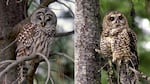
Barred owls, like the bird at left seen at the Malheur National Wildlife Refuge, often out-compete the Pacific Northwest native northern spotted owl, seen at right in the Deschutes National Forest.
Left image: Ray Bosch/U.S. Fish & Wildlife Service; Right image: Don Ryan/AP / OPB
The push to kill one kind of owl to save another has reached Oregon’s Elliott State Research Forest.
Beginning Thursday, contractors will begin shooting invasive barred owls inside the 83,000-acre state-owned territory, in an effort to protect northern spotted owl populations.
The state hired them to kill up to 350 barred owls over the next year as part of a bigger effort led by the federal government, according to Amy Price, research biologist at the Elliott state forest.
“We are using the U.S. Fish and Wildlife Service’s management strategy,” she said. “We could have come up with our own strategy, but we chose to follow them, because the science has already been done.”
That federal agency has authorized the killing of almost half a million invasive barred owls across Oregon, Washington and California — and has an unlikely array of allies and opponents. The Bird Alliance of Oregon says it reluctantly supports both the federal and state programs to kill barred owls as part of a last-ditch effort to save the northern spotted owl from extinction. So do a number of environmental groups.
Small bipartisan groups of lawmakers at the state level in Oregon, and at the federal level in California and Texas, have fought against the plan, which was advanced under former President Joe Biden and put in place under President Donald Trump. Oregon’s U.S. senators, Democrats Jeff Merkley and Ron Wyden, support it.
Environmentalists have been fighting for decades to protect northern spotted owls, which nest primarily in old-growth forests, from logging. Those legal fights led to the owl being listed as “threatened” under the Endangered Species Act in 1990 and, in 1994, to the creation of the Northwest Forest Plan — which contributed to a drastic reduction in logging on federal lands in Oregon and Washington.
Related: ‘Timber Wars’ podcast, Episode 3: The owl
The invasive look-alike from the East Coast has accelerated the spotted owl’s decline.
To the casual observer, barred owls, which are native to the eastern U.S. and the Great Plains region, look very similar to the northern spotted owl. Both have round heads, a defined face, large eyes, and dappled feathers.
But barred owls are bigger and more aggressive than their West Coast cousins. They’ve outcompeted the smaller native bird for nesting spots and food despite conservation efforts.
Northern spotted owls are approaching extinction status in Washington state and on the Oregon Coast, according to a study published in August. While hundreds of barred owls now live in the Elliott State Research Forest, only three individual spotted owls were detected in the most recent survey, Price said.
That dire situation is behind the Bird Alliance of Oregon’s decision to offer its backing of programs to kill barred owls.
“We’re not supportive of killing barred owls so much as we’re supportive of saving the northern spotted owl,” said Joe Liebezeit, associate statewide conservation director with the Bird Alliance of Oregon. “Our backs are up against the wall.”
Some animal rights activists question that logic. The group Animal Wellness Action, which has funded a multi-state “Hoot, Don’t Shoot” billboard campaign, is seeking to catalyze public opposition to the barred owl killings.
Wayne Pacelle, president of Animal Wellness Action, calls the federal barred owl management plan “the largest raptor slaughter that any government has ever contemplated,” and said he worries that spotted owls will be killed by people charged with targeting the larger birds.
He also criticized the Oregon Department of State Lands for authorizing barred owl killings in the Elliott forest, saying the science does not support the thesis that shooting the invasive bird will lead the northern spotted owl to recover.
Price, the state forest biologist, disagrees with that assessment, and cites studies going back more than a decade that have found removing barred owls in Oregon, Washington and California has improved the survival rates of spotted owl populations.
Those findings also underpin the Bird Alliance’s reluctant support for barred owl cullings, Liebezeit said.
“We have the science on our side, indicating that removal can work in situations where we want to really bolster the recovery of the northern spotted owl,” he said.
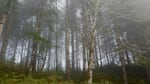
FILE - Coast Range fog settles on the Elliott State Research Forest near Coos Bay, Ore., in this photo from 2016.
Jes Burns, OPB/EarthFix
But the Bird Alliance will watch the results in the Elliott, and on federal lands, carefully, he said. “We will keep tabs on it, we’ll keep in conversation with our agency colleagues to see how it’s working, and our position could change.”
Given the northern spotted owl’s precarious status, “success” does not necessarily mean a boom in population — even a stable population would count as a win, Price said.
“If our baseline is three, then after 15 years if we have three or more (spotted owls) we would say that’s success,” she said. “If we have two or less, that would not be successful.”
Barred owl removal in the Elliott State Research Forest will cost about $15,000 per month over its first 16 months, Price said. After that initial period, she estimates ongoing barred owl removal will cost another $6,000 per month.
The Oregon Department of State Lands has hired contractors who are already experienced at detecting and tracking owls in the forest, and who also have experience as marksmen and firearm safety instructors, she said.
Correction: An earlier version of this story contained a typo misstating the name of the Elliott State Research Forest. OPB regrets the error.