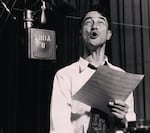
In this undated image, voice actor Pinto Colvig records at Disney Studios.
Courtesy of Southern Oregon Historical Society
If you’ve seen any early Walt Disney or Warner Bros. cartoons, you’ve heard the voice antics of Pinto Colvig.
Born and raised in Southern Oregon, Colvig created the original Goofy, along with dozens of other characters including Bozo the Clown.
‘A children’s book that talks!’ Capitol Records, Inc., 1946
In 1946, Colvig created the voice of a red-haired, red-nosed circus clown named Bozo, along with at least eight other side characters, for the children’s record “Bozo at the Circus.”
The record became a bestseller and soon Colvig was portraying Bozo on TV. Eventually, the character was franchised to local television stations, which produced their own programs across the country.
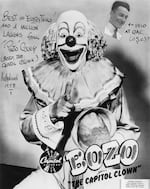
This signed press image from 1958 shows Bozo, "The Capitol Clown," as part of Capitol Records advertisements for Bozo books.
Courtesy of Southern Oregon Historical Society
‘Pinto’ the clown
Colvig was born on Sept. 11, 1892, in Jacksonville, Oregon. He was named Vance, but the other kids called him “Pinto” due to his freckled face.
From an early age, he proved to be a prankster and gifted mimic, reproducing the sounds around him and making funny faces to make people laugh.
His mischievous sense of humor comes through in his autobiography, “It’s a Crazy Business,” stating, “Even at a tender age, I could imitate a baby cry perfectly, but no one about the household appreciated it.”
In 1905, at just 12 years old, his father took him to Portland to visit the Lewis & Clark Centennial Expo, where he talked his way into a job entertaining visitors as a clown.
As a teenager, his family moved from Jacksonville to the more bustling town of Medford. With its busy railroad stop, traveling circuses and carnivals appeared a few times a year.
He wrote, “What a joy it was when one of these gaudily painted showcars came pullin in hitched to the back end of the train. Actors, musicians, gals and general show folks, dressed up fit to kill.”
He usually found some way to briefly join the troupe through odd jobs or, sometimes, even performances.
OAC’s special student
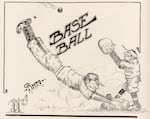
Pinto Colvig drew this cartoon in 1912 for the Oregon Agricultural College (now Oregon State University) newspaper.
Courtesy Oregon State University Libraries Special Collections and Archives Research Center
Colvig never got beyond 8th grade, but in 1912 he managed to enroll as a special student at Oregon Agricultural College, now known as Oregon State University.
In college, Colvig studied drawing and illustration and worked towards becoming a commercial cartoonist.
He was known around campus for performing as “Pinto, the Nightmare of Caricature,” where he created on-the-spot drawings of audience members while ad-libbing for laughs.
Eventually, he quit school altogether and traveled around the country with vaudeville troupes, carnivals and circuses.
The first colored cartoon
By 1916, Colvig landed in San Francisco with a wife and growing family. He took on multiple jobs: writing a daily column with illustrations, drawing syndicated cartoons and opening his own animation studio.
He wrote, “I dabbled considerably in the pioneering of animated cartoons. The Encyclopedia Britannica credits me as having made the first colored animated cartoon in 1919.”
The animated short “Pinto’s Prizma Comedy Revue” is considered a lost film. The Southern Oregon Historical Society holds a few stills of an even earlier animation Colvig worked on called “Creation.”
In this same era, another animator was also just starting out in Kansas — Walt Disney. Disney wouldn’t release a colored animated movie until 1932 with the short “Flowers and Trees.”
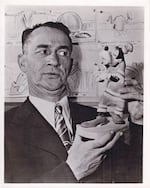
In this undated press image, Pinto Colvig poses with a figurine of Goofy, one of Colvig's many character voices.
Courtesy of Oregon State University LibrariesSpecial Collections and Archives Research Center
Pinto goes to Hollywood
In 1922, Colvig moved to Hollywood, working as everything from a writer and actor to an animator and special effects artist.
Eventually, he joined Disney, where he became best known for creating the voice of Goofy. He voiced both Grumpy and Sleepy in the classic movie “Snow White.”
Other projects included voicing a Munchkin in “The Wizard of Oz” and providing sound effects for Warner Bros. cartoons.
“— Capitol Records, 1946The band plays, the animals talk, and Bozo tells the story.”
In 1946, Walter Livingston of Capitol Records contracted Pinto to record the original Bozo the Clown record album. The read-along book included two records featuring Bozo and a cast of other characters.
The book proclaims, “For the first time in recording history, Capitol presents an entertaining story for children that is ingeniously synchronized with sight and sound.”
It also assures readers that Colvig is a former clown: “Mr. Colvig’s technical advice regarding the circus and circus life insures the accuracy of the story.”
The picture book and record combo became an instant hit, and more records and merchandise soon followed. Three years later, Colvig starred in his own show, “Bozo’s Circus,” on KTTV in Los Angeles.
In the 1950s, Capitol Records sold the licensing rights to the Bozo character. This allowed television stations worldwide to license the character. Stations hired their own actors to play Bozo in localized children’s TV programming.
One of the most well-known versions aired on WGN-TV in Chicago from 1960 to 2001.
Eventually, Pinto’s son Vance Jr. took over the role for KTTV.
In 2021, actor and director David Arquette purchased the rights to the Bozo the Clown character.
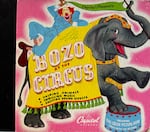
FILE: Pinto Colvig voiced the characters in this Capitol Records book and record set "Bozo at the Circus," published in 1946.
Courtesy Capitol Records

More Oregon clown content? We’ve got you:
- Read more about Pinto Colvig’s life in this Oregon Encyclopedia entry
- The inspiration behind Krusty the Clown of “The Simpsons” fame