FILE: A cow on Josh Walton's property walks in front of a data center in Umatilla, Ore., on April 3, 2026.
Saskia Hatvany / OPB
Kelly Doherty had been in elected office for less than a month when Amazon reached out.
In a July 2023 email, an Amazon representative congratulated Doherty on winning a seat on the commission that oversees the Port of Morrow in Eastern Oregon and offered to introduce her to Sheena Sharma and Courtney Lee.
Sharma and Lee weren’t just any Amazon employees. Three years after Doherty received the email, Amazon selected the pair of executives to make the case for data centers to legislators in Salem during a September public hearing.
From Oregon’s highest corridors of power to an inland industrial port serving a rural county of 12,000 people, Amazon has spent the better part of the past 15 years ingratiating the company with government officials and elected representatives as the tech and e-commerce giant has steadily expanded its data center footprint in the state. But more than a decade of behind-the-scenes work hasn’t prevented the political winds from rapidly shifting against the data center industry.
A recent poll commissioned by OPB showed that nearly two-thirds of likely Oregon voters favor a temporary ban on data centers. An even bigger group — more than 70% — are against a data center being built near their home, according to the survey conducted by the nonpartisan firm DHM Research.
The two major party candidates for governor – incumbent Democratic Gov. Tina Kotek and Republican state Sen. Christine Drazan – have already noticed the shift in opinion. Recent polls by OPB and the Oregonian/Oregon Live show the candidates are in a statistical tie. Both candidates have lately come out in favor of a moratorium on new data centers, while attacking each other over not doing more to crack down on them previously.
Amazon has noticed too. It’s not the only data center company in Oregon, but it has one of the largest buildouts through its base of operations in Morrow and Umatilla counties. The company has attempted to burnish its image in the state by sponsoring more events in Eastern Oregon. This month, it pledged $1 billion dollars to offset the impacts of the data center industry nationwide, and the company stepped up its political contributions to Oregon legislators from both parties.
A potential moratorium could have significant ramifications for Eastern Oregon. Amazon has four data centers in Morrow County alone, with local approval in hand for 10 more. The company’s footprint is even larger in neighboring Umatilla County, where boosters like Umatilla County Commissioner Dan Dorran say Amazon is a great partner to local governments.
“I don’t know on what grounds we would ban them,” he said about efforts to impose a local moratorium on data centers.
But others, like Doherty, have become more skeptical as data centers have grown more prominent. Around 1,000 Eastern Oregon voters elected the port commissioner three years ago, and when she first ran, her top campaign issue was not data center development. Now, Doherty actively opposes the industry.
“This isn’t Oregon,” she said. “Not the Oregon I grew up in.”

FILE - Oregon Gov. Tina Kotek waves goodbye to the crowd after speaking against data centers during a protest advocating for a statewide data center moratorium in front of the Oregon State Capitol in Salem, Ore., on Sept. 8, 2026.
Eli Imadali / OPB
Data centers hit the political stage
The anti-data center political ads started in early September.
Drazan’s ad was first, accusing Kotek of having “rolled out the red carpet” for data centers through the state’s tax incentive program. Kotek fired back a few days later with an ad that said Drazan “put data centers ahead of Oregonians” when Drazan voted against the POWER Act, 2025 legislation that required some operations to pay more for electricity.
The back-and-forth continued at a debate between the two candidates earlier this month, where Drazan dismissed the POWER Act as a “gimmick” that targeted “small communities.”
Both candidates are campaigning like it’s a close race. The DHM Research poll commissioned by OPB showed Drazan with a 2% lead. Another recent poll commissioned by The Oregonian/OregonLive had the results reversed, with Kotek coming out on top by two points. Both poll results were within the margin of error.
But as the two major candidates for governor consolidate against data centers, a new group called Oregon Connects is pushing back with TV and web ads of its own.
“There’s a lot of misinformation about data centers. Here are the facts,” a narrator says in one Oregon Connects advertisement before touting the energy and economic benefits of data centers.
Oregon Connects was founded in March by the Data Center Coalition, a national industry group whose membership includes Amazon, Google and Meta.
Roger Wehner, vice president for economic development for Amazon Web Services, said in an interview these commercials were a chance for Amazon to share its environmental stewardship.
“All we can do is tell people how we operate, our commitments to the environment and responsible development, and how we partner with our utilities and others to be good partners in the community. Sharing that is super important,” he said.

FILE - Sen. Christine Drazan responds to questions during the gubernatorial debate in Eugene, Ore., at the University of Oregon on Oct. 1, 2026.
Will Yurman/Pool LookOut Eugene-Springfield
While Oregon politicians might be publicly taking a more skeptical stance to data centers, Amazon continues to donate to both Republican and Democratic campaign accounts.
State records show that Amazon has spent $65,000 on contributions to a bevy of sitting legislators, statewide officials and political groups since September 2024. That includes Drazan, who received $2,000 from Amazon last December.
Amazon isn’t just sending money to candidates directly, but also to groups like the Sustainable Agriculture and Energy Political Action Committee, or SAGE PAC. The committee is controlled by three large Eastern Oregon farms, and Amazon began contributing in 2023. The tech giant has since become its biggest donor.
Amazon has given $40,000 to the PAC in the last three years, as it doled out donations to politicians, mostly to sitting lawmakers. Both Kotek and Drazan have gotten donations from the SAGE PAC, but Kotek got her only contribution in 2020, when she was still the Oregon House speaker and before Amazon got involved with the committee.
Wehner said he wasn’t involved in Amazon’s political operations but said the company was “happy to engage in all levels of government.”
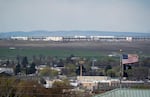
FILE: A "hyperscale" data center owned by Amazon can be seen on the outskirts of Hermiston, Ore. on April 1, 2026.
Saskia Hatvany / OPB
A billion-dollar pledge
Farmer Barrett Dash grows a variety of crops in Morrow County, including sunflowers, hay and medical cannabis. He said he relocated to the small town of Irrigon to escape the “unmitigated” growth of Central Oregon and now fears something similar is happening in Eastern Oregon with data centers.
While Dash worries that data centers will compete with farmers for water, he’s also wary of the way Amazon does business.
Amazon has long asked local public officials it works with to sign non-disclosure agreements, or NDAs, a way of keeping many details of its projects confidential until they are done deals.
“A lot of the activities that have happened out here have happened totally behind closed doors, with no input from the public at all,” Dash said.
But Amazon is changing its approach. This month the company announced it was no longer going to ask public officials to sign NDAs. The policy change was accompanied by a promise to spend $1 billion nationwide on communities with Amazon data centers.
Wehner said non-disclosure agreements are a standard feature of economic development, a way for Amazon to protect itself against competition and keep a low profile as it evaluates business opportunities.
But he admitted that the public was starting to view Amazon’s use of NDAs negatively.
“We never did any of this to hide anything, just to reduce cost structures,” he said. “We hear everybody, and it can be perceived the wrong way, and we want to remove that perception.”
Amazon also used its announcement to warn against the crop of data center moratoriums popping up around the country, with a company executive saying the effort to meet demand for AI was a matter of economic and national security.
Wehner said Amazon has created prosperity in Eastern Oregon, and a moratorium would only slow that down. The company says it has contributed more than $70 million in taxes to Morrow and Umatilla counties despite taking advantage of the state’s tax incentive program, while its Eastern Oregon operations employ more than 2,500 full-time staff.
Wehner added that Amazon already holds itself to a high standard, and instead of proposing bans, governments should negotiate with the company to address their concerns.
A recent report from ECOnorthwest and the University of Virginia added some fuel to the debate. It found that data centers account for nearly a quarter of all retail electricity sales statewide. Researchers expect data center energy consumption to continue to rise over the next several years.
Dorran, a Umatilla County commissioner from Hermiston, said data center technology was advancing at such a pace that a lot of the environmental concerns Oregonians have were already being addressed.
“Like all good partner industries, I hope our relationship stays strong,” he said. “And as we scale our partnership, that the community is always first in mind.”
But support from some local governments hasn’t kept the idea of a local moratorium from cropping up.
Dash is supporting a petition from La Grande nonprofit Oregon Rural Action to institute an immediate moratorium on data centers in Eastern Oregon specifically. The group hopes to collect 1,000 signatures to encourage local officials to support a ban.
Dash admitted Amazon had brought some economic success to Morrow County. But the benefits simply didn’t outweigh the costs.
“We cannot eat, drink, or breathe data,” he said.

FILE - Port of Morrow Commissioner Kelly Doherty stands at her ranch near Boardman, Ore. on Sept. 28, 2026.
Antonio Sierra / OPB
‘Let Data Reign’
Kotek and Drazan’s positions on data centers put them at odds with the president.
In August, President Donald Trump wrote on social media that communities that rejected data centers would become “backwards and poor” and encouraged the country to “let Data Reign.”
Trump’s support for data centers is also felt in federal policy: A California energy company is currently developing a data center on federal land in Umatilla County, which means the development won’t go through local or state channels deciding land use.
Nearly two-thirds of likely Oregon voters view Trump negatively, according to the DHM poll OPB commissioned.
In speech after speech, Kotek has tied her opponent to the president ahead of a midterm election political observers expect will be a referendum on his policies and his party. Drazan’s stance on data centers allows her to draw a contrast with the president, without publicly criticizing him.
For her part, Doherty, the Morrow County port commissioner, said she’s skeptical that either candidate will follow through on their commitment to place a moratorium on data centers. She thinks their promises are just ploys to get votes.
Doherty never responded to that 2023 email from the Amazon representative, but that didn’t stop data centers from bleeding into her everyday life.
Doherty recently noticed some of the listings in Range Writer Magazine were changing.
The real estate publication advertises farm and ranch properties across the western U.S., but embedded among the usual ads was farmland explicitly marketed for potential data center development.
Doherty has had her own run-ins with people she called data center “speculators.” She said a real estate agent from California approached her family about selling their Boardman ranch for data center development, and she heard similar stories from her neighbors.
“They were certainly quite nice to us in the beginning, until we said, ‘We don’t want to live next to you,’” she said.
Doherty’s desire to protect farmland and other wide-open spaces has many sympathizers across the state. According to the DHM Research poll, 84% of likely voters support laws that “continue to protect farm, forest, and coastal lands in Oregon.”
With Morrow County becoming increasingly unrecognizable to Doherty, she wants to go a step further than Kotek or Drazan. In areas with water quality or shortage issues, Doherty wants a permanent ban.