Portland Public Schools Board Chair Eddie Wang appeared on OPB’s Think Out Loud Tuesday to hear from listeners about Portland’s recent announcement to “rightsize” the district by closing schools and making boundary and program changes. Last week, PPS leaders heard vocal opposition to its two options for making changes to district schools in response to declining enrollment.
“Scenario A” includes 14 school closures, boundary changes and program moves affecting 8,000 Kindergarten through eighth-grade students.
“Scenario B” would result in 11 schools closing, with other boundary changes and program moves, affecting 7,000 students.
The district shared several other changes that would take effect under either scenario. A third option is keeping the status quo and making no changes.
The author of the closure plan, PPS Superintendent Kimberlee Armstrong, is scheduled to appear on Think Out Loud on Friday. On Tuesday, just over a week after the closure plans were announced, board chair Eddie Wang took questions from host Dave Miller and OPB listeners.
Wang said that his initial reaction to the district’s closure plan was “shock”.
“At the same time, it’s an interesting mix of both sadness and excitement for what the future might hold in terms of stabilizing the system so that all our kids can have what they deserve,” Wang said.
However, sadness was the main feeling listeners shared Tuesday. Callers to Think Out Loud only shared their first name.
“It’s hard to string a sentence together when your heart is in your throat,” said Giles, parent of a Sunnyside Environmental School graduate and a current student. Under the district’s plans, Sunnyside would shrink down from a K-8 school to an elementary program, and lose its focus on environmental education.
“It should be considered one of the crown jewels of the PPS system.”
Several people came to the defense of schools that are slated to close completely.
“I don’t want my school to close because I don’t get to see my friends and teachers anymore,” shared Dahlia, a first grader at Rose City Park Elementary, in a voicemail.
“Why do we have to move so fast? Can we emphasize reflection over action? Can we do a tiered approach?” asked a parent at Sellwood Middle School, the only middle school proposed for closure under the scenarios.
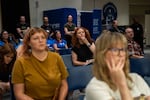
Attendees listen closely during a Portland Public School Board meeting about closing up to 14 schools, at Dr. Matthew Prophet Education Center in Portland, Ore., on Oct. 6, 2026.
Eli Imadali / OPB
Wang answered questions but also acknowledged the reality that PPS as a school system is smaller than it was in the past. Since 2019-20, PPS enrollment has declined by 11%, or about 5,200 students.
Wang said PPS started conversations related to closures even earlier, citing a committee that released boundary recommendations ten years ago. The conversations then were about boundaries and school building utilization, but Wang said past PPS leaders have avoided making tough decisions.
“Back then, the leaders were not encouraged or brave enough to make the changes that were recommended, so … the can got kicked down the road, and we’re at a point where there’s no more road left to kick the can,” Wang said.
PPS’ current plan sets a couple of deadlines: next month, Superintendent Armstrong is scheduled to present her recommendation to the school board, with a vote on the recommendation in December. Currently, PPS is hosting community engagement sessions to hear from students, parents, families and staff.
Listeners shared their frustration with the process.
“The outreach feels like PR rather than collaboration,” said a caller named Wendy.
“We’ve yet to see a detailed transition plan that addresses the building vacancies, transportation costs, environmental impacts, employment matters, class sizes, childcare for working families and economic consequences,” said Michelle, another caller.
“So I think the board should not vote to move forward with any school closures until this information is provided for every impacted school in the district.”
Serena, another listener, left a voicemail sharing how her experience as a teacher at Aloha High School in Beaverton informs her thinking as a parent of two students at Stephenson Elementary, one of the schools proposed for closure. Serena said she sees her students find success in school because of the community they’ve built.
“[It] informs a lot of my thinking about the dangerous, unintended consequences that we might experience closing elementary schools in Portland,” Serena said.
Wang has called himself a “veteran” of PPS’ Southeast Guiding Coalition, which started in 2020 as an effort to balance neighborhood boundaries and program offerings in several schools. He described his own experience as a parent representative on the coalition and the benefits he saw from that process, like Lent Elementary School serving more dual language immersion students. Under current proposals, Lent would receive students from Atkinson Elementary’s DLI program.
A parent of an eighth grader at Mt. Tabor Middle School mentioned that the SE Guiding Coalition process left her child’s school underenrolled. But as part of the current boundary change proposals, Mt. Tabor is expected to receive middle schoolers from Laurelhurst, as that school would change from a K-8 to an elementary school. Mt. Tabor would grow by nearly 200 students, according to district projections.
“It’s important to recognize there are some options in this plan that to me do make a lot of sense,” the parent said.