
A new report examining how Black Oregonians have fared in recent years found significant gains in measures of civic engagement, such as voting and political representation, but almost no progress in education metrics, such as the number of Black teachers in Oregon classrooms.
The full report by the Urban League of Portland compares statistics going back at least 16 years and will be released next month. But researchers released top-line findings last week during a panel event at Portland State University’s Urban Center Building.

From left to right: Youth librarian Aislyn Brown; writer and community advocate Lakayana Drury; and Portland State University Black studies professor Bright Alozie speak on a panel after the presentation of the 2026 State of Black Oregon report at Portland State University, Oct. 6, 2026 in Portland, Ore. The full report, due to be released next month, sparked conversation about what improvements the panelists would like to see in a future study 10 years from now.
Riley Martinez / OPB

Jazzmine Waugh, who led the study for the League, walked students, academics, nonprofit leaders and community members through the 2026 State of Black Oregon.
The report, following a similar study released in 2015, offers new data on strong gains as well as persistent challenges facing Black Oregonians.
“It’s been a long, hard road,” Waugh said after the presentation. “How do you advocate for and represent Black people from all throughout Oregon?”
According to census data, more than 100,000 Black Oregonians live in Oregon, making up about 2.5% of the state’s population of 4.2 million.
Voting and political representation
According to the report, some of the strongest improvements were made in civic engagement.
It found voter registration among Black Oregonians increased 24% between 2012 and 2024. In that same period, the percentage of Black Oregonians who voted rose from 37% to 63%.
One of the panelists, PSU Black studies professor Bright Alozie, said multiple pivotal moments of the 20th century — like the Civil Rights Movement — have spurred Black Oregonians to organize politically.
“What we are seeing is a culmination of a much larger history,” Alozie said.
More recent and ongoing events, he said, include federal funding cuts and threats to mail-in voting in Oregon.
“Participation often rises when people feel their access or services are at stake, as they are right now,” Alozie said.
Joy Alise Davis, executive director of Imagine Black, also said the racial justice protests of 2020 were “a really big moment for Black people” and sparked even more participation.
“We’re realizing that to be Black in Oregon is inherently political,” Davis said.
Waugh also said the percentage of Black representation in both chambers of the Oregon Legislature has roughly doubled between 2015 and 2026, an indication of people “wanting to platform and pay attention to the issues that the Black community are facing.”
Former Multnomah County District Attorney Mike Schmidt, who now serves as in-house general counsel for the Urban League of Portland, also praised those increases.
“I think we’ve seen over the last couple years now democracy be under attack, and so to see that people are increasingly exercising their right to vote, I think, is such a positive thing,” Schmidt said.

Former Multnomah County District Attorney Mike Schmidt — now general counsel for the Urban League of Portland — speaks with a community member following a presentation of the latest State of Black Oregon at Portland State University on Oct. 6, 2026 in Portland, Ore. Dozens lingered after the presentation and discussed the top-line findings from the study about the gains and challenges facing Oregonians.
Riley Martinez / OPB
Shifting health outcomes
Black Oregonians have seen some gains in health outcomes since the early 2010s, the new data show.
The report found fewer Black Oregonians died of cancer in 2024 than in 2015. It also showed a drop in diabetes diagnoses between two three-year periods in the last decade.
But other study results — particularly those around mental, maternal and infant health — didn’t see those same improvements.
More Black Oregonians died by suicide in 2024 than in 2017, and the rate for suicides among Black youth ages 10-24 hasn’t changed since 2014.
And between 2016 and 2024, the percentage of infants born to Black mothers with a low birth weight increased from 9.4% to 10.7%, compared to a smaller increase among infants born to white mothers.
“And that leads to all kinds of negative health outcomes, especially in the long term,” Schmidt said. “When you start thinking about health outcomes, you’re talking about housing, you’re talking about food and you’re talking about education.”
Ongoing challenges in education
The report said education, a long-acknowledged road to upward mobility, still raises many barriers for Black students in Oregon.
The report found a lower percentage of Black children received early intervention services for disabilities than white children in the 2020-21 school year, when the COVID-19 pandemic was putting additional strain on schools.
Mirroring some ongoing challenges for students across the state, English and math proficiency among Black students declined between 2014 and 2025 for both fourth-graders and high schoolers.
In that same period, the percentage of Black students with one or more disciplinary incidents rose more than it did for white students.
The report also found a minimal rise in the percentage of Black teachers compared to Black students. During the 2024-25 school year, 2.5% of Oregon students were Black while just 0.9% of the teachers were Black.
Writer and nonprofit leader Lakayana Drury, who was on a panel discussion that afternoon, leveled criticism at the state’s education system. That included Portland Public Schools, which recently proposed closing up to 14 school buildings across the district.
“It’s not just directly to PPS, but I question whether public schools are even capable of educating Black students as a whole, and when we look at these results, they don’t support it,” Drury said.
“How are you gonna get Black teachers when the school district at a baseline can barely retain the teachers it has?”
Higher education fared better, with the percentage of Black Oregonians holding a bachelor’s degree increasing from 17% in 2015 to 22% in 2023.
Economic outcomes remained mixed
The percentage of Black-owned businesses in Oregon increased from 1% in 2012 to 3% in 2021. And unemployment among Black Oregonians above the age of 16 dropped from 2015 to 2024.
The report found the gap in yearly income between Black and white households widened by about $9,000 between 2010 and 2023.
The percentage of Black households that own the units they live in also fell between 2010 and 2024.
The number of Black households with extremely low income — less than 30% of the median family income — between 2010 and 2021 has largely remained the same when adjusted for inflation.
Stalled improvements on criminal justice
While the percentage of incarcerated Black adults has stayed the same, the percentage of Black youth in juvenile detention increased from 8.6% in 2015 to 14% in 2024.
Between 2019 and 2024, the percentage of traffic stops for Black Oregonians barely increased while the pedestrian stops went up, from 7.1% to 8.6%.
Community members look to next decade
After her presentation of the data, Waugh asked the panel what they would want Black students to see in an updated report some 10 years from now.
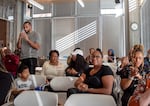
Community members, nonprofit leaders, students and academics applaud panelists at a presentation of a new report by the Urban League of Portland at Portland State University Oct. 6, 2026 in Portland, Ore. The report, called The State of Black Oregon, offers new data on how Black Oregonians have fared in recent years across several measures, from education to health outcomes.
Riley Martinez / OPB
Alozie said Black students need to see evidence that they’re “thriving in a robust educational system.”
“I hope that they see that Black graduates, whether high schoolers or college graduates, that they are finding real definitive paths in their careers.”
Alozie also called for a future where Black Oregonians can decide to leave the state not out of necessity, but out of choice — something he calls “durable belonging.”
“Durable belonging means, ‘Can I afford to live here as a black person?’” Alozie said. “‘Can I buy a home without going through the hoops and without all those barriers that prevent me from owning a home as a Black person?’ Durable belonging means, ‘Can I even raise my children here?’”
That resonated for Sierra Warren, who works in communications at Portland-based social services nonprofit Self Enhancement Inc.
“As a young professional, I want to see my other Black — especially female — counterparts and peers want to stay here,” Warren said. “I want people to want to be here because it’s fruitful for them.
Sabrina Taylor, a PSU student, said she wants to see higher literacy among Black students, a desire rooted in her own love of reading after struggling with it as a kid.
She remembers staying up at night learning how to sound out words using the “Hooked on Phonics” books her parents bought her, which soon turned into an obsession with reading, then history.
“20 odd years later, I’m here at Portland State, majoring in Black history in hopes that I could take that education and pour it back into my community,” Taylor said. “I wanna prove that, you know, this is a great place to be Black, young, educated.”