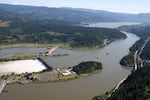
Boneville Dam, on the Columbia River. Washington consumes about 20% more hydropower than Oregon.
Amelia Templeton
Residents in the Northwest think that coal provides about 11 percent of the electricity consumed in the region and they would like it to provide less than 3 percent of electricity, according to a new EarthFix poll.
Davis Hibbitts & Midghall (DHM Research) of Portland conducted a survey of 1,200 people in Washington, Oregon and Idaho. It revealed that people tend to overestimate the amount of renewable energy available to consumers in the Northwest, and underestimate coal's role as a source of electricity.
While the Northwest primarily produces hydropower and renewable energy, the region also imports coal power and natural gas from other states.
Oregon and Washington, for example, have very different energy mixes. Washington gets two thirds of its electricity from hydro power, and 17 percent from coal. Oregon gets less than half of its energy from hydro, and a whopping 34 percent from coal. Why the difference? John Harrison, with the Northwest Power and Conservation Council, explains:
“Oregon is primarily a private-power state. In that the largest population areas are served by investor owned utilities. Washington is just the opposite. It’s primarily a public power state. “
The publicly owned utilities in Seattle, Everett, and Vancouver get almost all their electricity from the Bonneville Power Administration and the big dams on the Columbia.
The private utilities serving Portland and the Willamette Valley rely more on their own local and out of state power plants, which tend to burn natural gas and coal.
2009 Washington State Electric Utility Fuel Mix: Electricity Sales to Washington Customers by Fuel Source