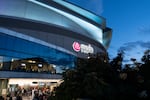
The Moda Center on Oct. 22, 2025 in Portland, Ore.
Saskia Hatvany / OPB
When the Oregon legislative session kicked off last month, state lawmakers had just five weeks to tackle a slate of priorities. One of those was a plan Democratic state and local leaders championed to keep the Portland Trail Blazers’ prospective new owners from moving the beloved basketball team out of Rip City.
Lawmakers in Salem moved closer to that goal with the passage of SB 1501 in the final days of the session. The bill received bipartisan support and allows the state to borrow $365 million by issuing bonds to help pay for the costly renovation of the Moda Center, the aging arena that’s home to the Blazers. The public financing plan has several conditions including: the Blazers’ sale to its new ownership group, led by Tom Dundon, gets approved by the NBA; the team agrees to a 20-year Moda Center lease; and the City of Portland and Multnomah County must also pitch in hundreds of millions of dollars for the renovation.
Joining us for a discussion about the public financing plan are Oregon Senate President Rob Wagner, who sponsored the bill, and Dewayne Hankins, President of Business Operations for the Portland Trail Blazers.
Note: The following transcript was transcribed digitally and validated for accuracy, readability and formatting by an OPB volunteer.
Dave Miller: This is Think Out Loud on OPB. I’m Dave Miller. When the Oregon legislative session kicked off last month or started at the beginning of this year, one of their big priorities was to try to keep the Portland Trail Blazers’ prospective new owners from not moving the beloved basketball team out of Rip City.
Lawmakers in Salem moved closer to that goal with the passage of a bipartisan bill in the final days of the session. It’ll allow the state to borrow $365 million by issuing bonds to help pay for a costly renovation of the Moda Center. There are some conditions to this public financing plan: the Blazers’ sale to its new ownership group led by Tom Dundon has to be approved by the NBA; the team has to agree to stay in Portland for 20 years; the City of Portland and Multnomah County have to pony up their own hundreds of millions of dollars.
Rob Wagner, a Democratic State senator from Lake Oswego and the Oregon Senate president, sponsored the bill. Dewayne Hankins is the Blazers’ President of Business Operations, they both join us now, and you can join us as well. How do you feel about this plan to spend hundreds of millions of dollars of taxpayer money to refurbish the Moda Center and to keep the Blazers in Portland? [live calls were taken during the program and answered by Miller]
Rob Wagner and Dewayne Hankins, it’s great to have both of you back on the show.
Dewayne Hankins: Yeah, great to be here.
Rob Wagner: Thanks so much, Dave.
Miller: So Dewayne, first – why does the Moda Center need to be renovated?
Hankins: Thank you, Dave. It’s built in 1995, 30 years old, the oldest building in the NBA that has not seen a major renovation. So it has all of the things that need to happen to a 30-year-old building to get it up to date, up to speed, all of that. And then there’s a lot of things … fans have changed the way that they watch games. So you used to scan your ticket, go sit down and enjoy the game. And now these event spaces are a lot more … fans roam around the concourse. They want to check out different areas of the building and that sort of thing. And then third, it’s the technology piece. We did a big scoreboard update last summer. That’s the start of it, but there’s a lot of work that needs to happen to get the building in a great spot.
Miller: How does the Moda Center compare to other NBA arenas right now?
Hankins: It’s a first class facility for sure, so the building’s in great shape. We’ve done a great job of keeping it updated for the last 30 years so it’s certainly ready to have the 200+ events that it has every year. But we’re trying to create the building for the future, for the next 20 years.
Miller: I wanna play you a voicemail that came in. This is Maya Page.
Maya Page [voicemail]: I love the Blazers. I just went to a game. I had a great experience. I’ve been to several this season. The stadium looks awesome. I feel like it matches Portland. It isn’t all shiny and sparkling like many of the other stadiums, and I like that. I think it matches us.
Miller: I was intrigued by what Maya is saying there because I guess I’ve been a little bit confused by the implicit argument that the Moda Center has to be on par with other NBA arenas. Because how much are you competing with the folks who run arenas in Salt Lake City, LA, Philly or Oklahoma City, all over? My understanding is that, in general, the folks who are going to Blazers games, concerts or big events there, are people who live within 50, 100 or maybe even 200 miles of Portland. But it’s not like if someone goes to the Moda Center, or doesn’t go there, it’s because they’re going to go to the Staples Center or whatever it’s called now.
So how do you think about this question of competing with arenas that are maybe 1,000 miles away?
Hankins: Yeah, I think there’s two parts to that. One is, we are competing to get great events, right? So we have the 2030 Women’s Final Four coming to Portland. That’s gonna be an incredible event. We would love to use that event as a stake in the ground to say we can do big events and have big events. So that would lead to the WNBA All-Star Game or the NBA All-Star Game. So in that context, we’re competing.
Miller: The competing for events as opposed to competing for people once the event is booked and is going to be at the Moda Center?
Hankins: Yeah, and then the second part of your question, which is about the building feeling very Portland, that’s very intentional and that won’t change. We can’t take what has happened in Golden State with that arena and say, “oh, let’s just copy and paste what they’ve done.” Whatever we do, it has to fit Portland, has to have our local restaurants, has to have our local flair, the weirdness that Portland is. That won’t go away in a renovation.
Miller: How much money are you saying all the combined renovations are gonna cost right now?
Hankins: We’re saying it’s about $600 million on a three off-season project. So that’s primarily the project.
Miller: If it’s $600 million – and maybe Rob Wagner, this is where I can bring you back into this conversation – the combined commitments from state, city and county governments that are being talked about right now – or pledges, if everything falls into line – are way above that. They’re about $870 million. How do you explain the difference there?
Wagner: I think we start with the idea that the legislature was looking at Oregon’s arena. So this was the arena fund. A lot of why this legislation that we passed with that big appropriation was supported by state senators from Wallowa County, Port Orford and Ashland is because they understood the economic development argument and the importance of the arena.
Specific to your question, in terms of the financing model – and it was really good in terms of the development of the legislation – we wanted to make sure that we were locking in a two decade-long commitment from the anchor tenant for Oregon’s arena. As you mentioned, over 200 days a year, the facility is used for graduations, concerts and everything else. And maybe the people don’t see that the bones of the arena are decent, but it really has a bunch of structural needs that need to happen behind it.
The way that the money is from the legislatures, we’re sequestering the anticipated income from all of that activity to be able to put into our share of what the arena costs would be. So we feel very confident there was a lot of good research done in terms of the state appropriation side on this.
Miller: But back to just this basic question about how much money you need to borrow, you and other public entities, to pay for these renovations ... If Dewayne Hankins in the Blazers are saying, “we think it’s going to cost about $600 million,” why borrow over $870 million?
Wagner: I think you’d really need to be asking the city and the county, in terms of their share of this. When we looked at setting up the arena fund … And again, I want to stress that this is Oregon’s arena. This is a publicly-owned asset right now by the city, and the state would be coming in as a partner to be able to do the renovation, make sure that things are needed so that we don’t become a flyover city, so that people are coming in, coming over the top. We want to make sure that it’s economic and cultural, and community oriented too.
In terms of the financing, I’m not exactly sure where those numbers are coming from. But on the state side, we felt very confident about the commitment that we were doing, in terms of the anchor investment with state bonding.
Miller: The numbers that I’m using are a $400 million possibility from the City of Portland, if they approve that, and $100 million from Multnomah County. Then add that to the $365 from the state and that’s how I get $870 or so million dollars.
Hankins: I can address that.
Miller: Please.
Hankins: There’s the $600 million renovation that we anticipate happening over three years. So that’s roughly $200 million worth of work that would happen every summer. And then to keep the building going and ongoing capex [capital expenditure] and maintenance for the next 20 years, there will be money that gets added to that pile.
To talk a little bit about that, there is a facility fee that has been paid by the Blazers and the Rip City Management for the last 30 years. So every ticket that gets sold has a 6% fee on it. All of that money for the first 30 years of this lease deal has gone to the City of Portland and has been used on other venues. In the next 20 years of the deal, we will still pay that fee. That’ll still be a revenue share that goes to the city. And now that money will come back to the Blazers for the annual ongoing capex.
Miller: Let’s take a call from Kim, who’s called in from Neskowin. Kim, go ahead?
Kim [caller]: Hi, I’m absolutely opposed to this. I’m a 71-year-old woman. I see the schools in Oregon crumbling. I see roads that aren’t taken care of. Let’s start letting the billionaires who own these venues – so not the building itself but certainly the Portland Trail Blazers – let them pay for it.
I’m exhausted by taxpayers not putting the money where it really needs to go, which is in the children. We need to start taking care of, sheltering and feeding the children before we spend hundreds of millions of dollars on revamping the stadium for multi-multi-millionaires. So, I don’t get it.
Miller: Kim, thanks very much for that call. Rob Wagner, this is a question for you. And just to put one clarification there, it’s the City of Portland now that is the technical owner of the Moda. So the Moda Center would not be owned by Tom Dundon if the NBA sale of the Blazers goes through.
But her overall point there is, obviously, one that you’ve heard. And I’d love to get your direct response to why should public money go towards refurbishing this arena so that a billionaire, likely owner of an NBA team, won’t yank the beloved team from the city of Portland?
Wagner: Well, first I would start with, I think there was a real risk of the idea that, when you have a vibrant franchise right now, other cities want to get in on the action. So I think that the idea of keeping your anchor tenant ... I was just with State Representative Tawna Sanchez at a memorial service for Senator Avel Gordly, who used to represent North and Northeast Portland. I think it was a great reminder of how important Albina Vision Trust and everything that that community is doing to try to get back on its feet.
The reason we got bipartisan support from a state senator from Port Orford, from Wallowa County and from Ashland is because they understood the economic importance of the investment in this public arena. So $670 million of economic activity, that is spinning out. Income tax is paying for the schools, is paying for health care. As you can imagine, at the state level, we’re extremely sensitive to that.
The other final point I wanted to make was that the state steps up for cultural institutions that need investments. So, coming out of COVID and with the wildfires in Ashland, we weren’t gonna let the Shakespeare Festival in Ashland fail. We weren’t gonna let the Elsinore Theater in Salem fail. This legislature stepped up with significant investments in county fairs all over the state because we heard that this was a really important asset. But drilling in on the thousands of jobs, the economic activity, we need to make sure that we have the income tax revenue by making strategic investments in economic development.
Miller: Let me follow up on that. We got this from Mark Fulop on Instagram. He wrote, “Extensive research cited by think tanks and researchers (as diverse as the conservative Cato Institute and more liberal Brookings Institute) agree that there’s little evidence that public subsidies for sports arenas increase long-term economic resilience of a community. In light of this, how can you guarantee that this taxpayer subsidy will magically defy a research base that spans decades?”
Wagner: Yeah, and I would say, listen, I’m a Portland State University graduate and I was a college dropout. I actually graduated when U.S. President Bill Clinton was my graduation speaker in 1998 at the Moda Center.
Miller: It wasn’t called the Moda Center then.
Wagner: It was the Rose Garden, the Rose Quarter and it was phenomenal. But you don’t measure economic investment by thinking about the importance of something like that. The state legislature just put over $100 million into a partnership with Portland State University to be able to rebuild a new Keller [Auditorium] and you’re talking about the arts and everything else. I doubt that if you had Cato run a study at that, that’s going to show some sort of value added back. But when you’re talking about Oregon’s arena and the 200+ days of activity [with] everything else that happens inside that arena, I think with the jobs, with the economic activity, this is really a no-brainer. I was really proud of the bipartisan support from across the state we had for the legislation.
Miller: Let’s play this through, because no one’s talking about blowing up the arena, getting rid of what you’re calling Oregon’s arena. What we’re talking about here, the nightmare scenario as I understand it and has been communicated to lawmakers, city officials and state leaders, is if you don’t give us these hundreds of millions of dollars of public money, we will move the Blazers. So it would still be Oregon’s arena, but it would not have the Blazers. So what is your vision for what that would mean for the city and for the state?
Wagner: Well, again talking to Rep. Sanchez, on her floor speech to the House, I thought it was really telling. She said that the Trail Blazers, in terms of Rip City Management and everything that they do, is the furnace inside the house. So when you think about it, if you don’t have the Trail Blazers as this anchor tenant, the idea that you have a sustainable public arena of this size and scale doesn’t pencil.
I lived in southeast Washington D.C. in the late ‘90s when Dan Snyder picked up what is now the Washington Commanders and moved them out closer into Maryland. And it was 190 acres of just absolute blight. That happened near Anacostia. You see it over and over. Now, people might say, “Well, this was never gonna happen. They weren’t ever gonna move the football franchise out of D.C.”
Now they’re trying to figure out how they can spend hundreds of millions, billions of dollars to bring them back. Because they know, not just the economy, but also the cultural value and importance to the community. And again, I just want to stress the idea that we had Albina Vision Trust and a lot of the folks that have been historically disenfranchised in the African-American community. You go on the street out there with the sense of pride, and losing the Blazers was not something that they wanted to risk.
Miller: Dewayne, Portland City Councilmember Tiffany Koyama Lane told OPB recently that lobbyists for the Blazers told her they “have made it clear that elected officials will be blamed if the team leaves Portland.” At least three other city councilors told OPB that they’ve been told by Blazers representatives that their political careers would suffer if they did not agree to the deal. Can you describe the lobbying effort that you all put together?
Hankins: Yeah, I think for us the lobbying effort was really, really important. We are a team that has less than five years left on our lease. And the last time I was on the show I think we talked about how we were running short on time on that lease. And when you have a team that has that few years left on their lease and you have ownership changing the way that it was, there was the real risk that the team could leave.
I think our point in all of that was to share that that was not on the table, from our perspective. But most teams, when they start working through their leases and when they start talking about what the future looks like, they start with seven, eight, nine years left on their lease. So it was just far too close for us. I think we really wanted to make sure that there was action happening.
Wagner: I don’t want to interrupt, but I do want to say [that] the lobbying also happened in the state legislatures. You can imagine there’s over 1,000 registered lobbyists through the Oregon Government Ethics Commission. There was a really good team that was put together. If you go and watch the testimony that happened in committee, it was panel after panel of professional experts, people who had been hired in order to educate legislators about the importance of this asset. It was also Albina Vision Trust and JT Flowers. It was leaders of labor unions coming down. Now, they were registered lobbyists, but they were talking about the importance of their jobs and the future of the region. And I think people are seeing the need for strategic economic development in Portland, for the future of the region.
Miller: The lobbying packet from the team had these lines: “If the Portland Trail Blazers leave Rip City, we are losing far more than the tax revenue the Blazers generate for the general fund. It would have a devastating impact on the city’s national and international reputation, and would feed the ‘doom loop narrative’ we have all been working to refute.”
That language is not that different from what we’ve just been hearing from Rob Wagner. But Dewayne, if the basic argument is that the team would move without public money and these disastrous things would follow, did that mean you were told that by the incoming ownership group? Did they explicitly or implicitly say, “hey, spread this word because we need this public money?”
Hankins: No, never explicitly.
Miller: But then wait, never explicitly. So what was the implicit message?
Hankins: The implicit message is that the lease is almost up and there’s a new ownership group that does not have a natural local tie to Oregon.
Miller: That’s the reality that you were able to discern as a smart business person. I’m curious what the incoming business group told you?
Hankins: Nothing on that.
Miller: So this entire gigantic lobbying effort is based on an assumption that Dundon, if they and the group get the Blazers, that they would potentially or likely move the Blazers if this money isn’t spent?
Hankins: I don’t think assumption is the right word. So you have a team that has very few years left on their lease. You have a team that could potentially be portable. You have cities – not that I can talk to but that others can talk to – that are pushing really hard to get an NBA team. There’s one of 30 of them. We were hearing rumblings that those cities wanted access to this team. And we went back and looked, and the last major city that lost their team was the Hartford Whalers. And Hartford has no chance of getting another team. All due respect to the folks in Hartford, but that’s the kind of situation that we were concerned about.
Miller: Rob Wagner, I’m curious, just this week, some breaking NBA news from ESPN was that the League is going to add – and this is not confirmed, but it seems likely – expansion teams in Seattle and Las Vegas, two of the cities that basketball watchers thought might be the likely home of the Blazers, if the Blazers were to be moved.
So again, this hasn’t been confirmed yet, but put simply, if you knew that Seattle and Las Vegas were already going to get their own NBA teams, would that have taken some pressure off of you at the state level to come up with state financing for a Moda Center upgrade?
Wagner: Yeah, I think it’s a little if, shoulds and woulds into this space, and obviously that wasn’t something that we are operating on. I would come back to you though, the fact that there was a real risk. And I still think that there is a risk. The fact that you have a different structure around how people treat professional sports franchises from what you might have seen historically. These are valuable assets that communities know that are critical to the vitality of a city and a region. It’s a little bit about, “oh, should we gamble on the Trail Blazers leaving, or should we double down on the economic investment, the cultural asset that’s here and the community pride that we have?”
So again, for me, that’s why we got huge bipartisan support from legislators across the state, and it’s, “Go Blazers. Let’s go get tickets and watch Deni and Damian next year.” We’re gonna make a run at this thing.
Miller: Chris has called in from Hillsboro. Chris, go ahead.
Kris [caller]: Hi, I’m in my 70s and I have seen these stadiums where the fans go, they can afford it, they really enjoy being part of the whole game thing. And then it gets bought, public monies are put in and the regular fans do not get to go. They are outpriced. It becomes the elitist type of thing that is not available for regular people. I also think it’s a really bad investment of public funds. So, that’s all I have to say.
Miller: Kris, thanks very much for that call. And Dewayne, before I give you a chance to respond to her, let me read part of an email that we got yesterday from Peter Klim, who had a question about street pricing. And I think there’s a connection between what we just heard from Kris there and this email.
Just as a reminder, this is like what we have at the Portland airport where, as I understand it, vendors in the building there, they can’t charge more than they do in their other outside-the-airport locations. And it’s one of the many things that makes the Portland airport really wonderful.
Peter wrote this: “Street pricing is an equity issue and makes events far more accessible to the entire community, especially those with families. It’s also proven not to be much of a financial hit either, because the increase in purchases helps cover the smaller profit margin. If the community is putting up hundreds of millions of dollars, this seems like an easy concession for the team to make.”
What’s your response?
Hankins: Well, I think obviously the state part of this is done and we still have a lot of work to do with the city and the county. I don’t want to talk about the negotiations that we’ll have with the city and the county, but certainly something like that could be on the table.
The thing I’d like to address about the question is I do, again, really think that this arena has to look and feel like Portland. When you walk in, it has to look and feel like it’s Portland. We cannot have an arena that only works for the rich.
One thing we haven’t even brought up yet is the Portland Fire. That’s a huge organization that’s going to have a bunch of home games in the summer and they’re gonna have their home there as well. I think having the Blazers, having the Fire, having all the events that we do – family events, concerts, shows, what have you – we’re very aware that this is Oregon’s arena and that people, when they go in there, feel like they belong there.
Miller: I want to play another voicemail. Let’s have a listen.
Jonathan [voicemail]: Hi, my name is Jonathan and I’m calling from Southeast Portland. I’m a lifelong Blazer fan and I’m thrilled to see that the Blazers are staying here. I want to make sure that we get a good deal when we outlay this money and I want to make sure that the money we outlay comes back to us in discernible public benefit. So I’d be curious what Mr. Wagner and Mr. Hankins have to say about the things that the Blazers are willing to give on, so that the public recoups its money and it’s not an empty investment like so many stadium investments are.
Miller: Rob Wagner, you can go first on this. Obviously, it’s not up to you to say what the Blazers will do, but I’m curious what you want them to do?
Wagner: Well, I want everybody to know, who lives across the state right now and might be listening to the program, that when we started the conversation in the legislative session, we developed legislation that has some of the most robust sideboards of any outlay that we’ve ever made in terms of a general obligation bond. We have a locked-in lease agreement, an expectation. We know that if the team tries to leave, that we’ll end up in a really interesting negotiation. We also, in the bill, said that we’re going to hire our own negotiator to put at the table, to make sure that the public is vested. There has to be reporting back, into this investment.
And again, I just want to stress that we’re talking about the arena, we’re talking about the Blazers, 41 nights a year, home games. And we’re talking about the potential of even adding even additional opportunities for cultural and different events that are gonna happen. So it gets very caught up in Trail Blazers and Trail Blazers management. But this is Oregon’s arena. This is a publicly owned asset. So that was the thing that really tipped it for me, to go into that space.
But again, we want to make sure that the taxpayers are protected. We feel very strong in terms of the legislation that we passed.
Miller: And Dewayne Hankins, how do you respond to what we just heard there in that voicemail?
Hankins: I think for us, I mean, to keep in mind that the building, when it was built in ’95, [it was] privately built, privately maintained for 30 years, so hundreds of millions of private dollars have gone into the building. So this is really the first time that we’ve come together with the public in a partnership. And yeah, as the Senate president said, a lot of great sideboards which are really important, a lot of strong leadership, a lot of great questions that we got asked to make sure that this bill was going to make sense for everyone.
Again, I’d go back to the revenue sharing that already exists, in terms of the Spectator Facility Fund that goes to the city right now and has for 30 years. We will start to collect that to help renovate and keep the building updated and maintained. But this is a public-private partnership. There’s been a lot of private money that’s gone to build this building.
Miller: In the past?
Hankins: In the past.
Miller: Robert has called in from Portland. Robert, go ahead.
Robert [caller]: I’m wondering if the people of the state of Oregon through taxation can put up, as you showed, close to a billion dollars to invest in a building, why can’t we just buy the Blazers and be like Green Bay, Wisconsin, which owns the Packers, and they’ll never leave?
Miller: So Robert, we don’t know exactly, but I think the eventual potential price is not official, but I’ve seen estimates of over $4 billion – $4.3 billion or something, is in my head. So before I ask that question of our guests, are you saying you want Oregon taxpayers to spend $4+ billion dollars to buy a National Basketball Association team?
Robert [caller]: I didn’t know the number was that high, so maybe not.
Miller: Do you have the money?
Robert [caller]: No, I don’t.
Miller: Okay, I was just asking.
Robert [caller]: I don’t.
Wagner: Robert, let’s talk offline.
Miller: OK, so does that change your thinking?
Robert [caller]: It does. It makes me wonder what the name “Blazers,” just the name, is worth. And maybe somebody could have this team and call them, you know, the Chattanooga Choo Choos or something. But we would have the name Blazers. And we could have a team that the people of Oregon would be proud of.
Miller: Well, Dewayne Hankins, it’s worth saying, just as a reminder – you don’t need this reminder – but, I don’t think the Supersonics exist in name anywhere right now. And when they became the Oklahoma City Thunder, which was a different time but not that long ago, the Sonics just disappeared.
Hankins: Yeah, exactly. And I think I said this in my prepared remarks at the Senate. But there’s two things I always think about. One is Harry Glickman, when he had the vision to bring this team [to Portland] – and I know you had Marshall on a few months ago at the Rip City Forever Group. But without Harry’s vision to make this a professional sports city and put Portland on the map, it never would have happened.
Then the second time was when Paul built the arena. I just think that there’s so much import in having a team here. And as you’ve seen with the Sonics, that team left in 2007. So it’s been 19 years and they’re maybe talking about adding a team in Seattle, two decades later. So if Portland were to ever lose this team, it really gets challenging to find when you could have a franchise again.
Wagner: Can I put 30 seconds in on Oklahoma? Because people might be surprised that Democrats and Republicans at the state level actually do develop friendships. And Lonnie Paxton, who is my counterpart in Oklahoma ... And right now they’re talking about massive public investment. But he would go back and talk about what happened in Oklahoma City 20 years ago. And he said it’s incredible what has happened in terms of the investment. For them, it was one of the best things that ever happened to that state. It was for sure one of the best things that ever happened to the city.
Miller: We have time to play one more voicemail that came in. Let’s have a listen.
Suzanne [voicemail]: My name’s Suzanne, and I’m the parent of a senior in Portland Public Schools. And I’ve been advocating for our legislature to greatly fund our public schools for over a decade. When I was in Salem on February 23, along with over 50 parents from around the state, to ask our legislators to help our public schools avoid more cuts and closures, the Trail Blazers were hosting a party with food and drink in the lobby of the Capitol building. The Blazers mascot and cheerleaders were there for photo ops with legislators.
All day, legislators told parents there wasn’t any more money for schools. Our schools are older and in worse shape than the Moda Center. PPS is looking to close five to 10 schools next year, as are other districts around the state. The Democratic leadership’s mantra is keep Oregon business in Oregon. How do you entice businesses when your school’s academic outcomes are among the worst in the nation? You can’t keep employees if they don’t like the schools. You can’t find workers if they aren’t well educated.
Miller: Rob Wagner?
Wagner: I would definitely say keeping what you have is exactly what we are trying to do, in terms of economic development – $670 million every year of economic development, in terms of Oregon’s arena. Think about losing that as an economic engine for the region. The personalization of this is really important. Both of my sisters are teachers in Portland Public Schools. One who’s actually looking at almost retirement and the other one teaches at Sunnyside Environmental School.
I think that we can walk and chew gum at the same time. The fact that the legislature passed the Student Success Act a few years ago and we’re bringing that funding on, Portland faces some really difficult challenges in terms of declining school enrollment. The advocates from the parents is critical. And I was also proud of this legislative session at the end of the session because of what we were able to achieve. We held the line in terms of not cutting additional revenue out of our schools. Long way to go. We could do better.
We need to ask our local community to do better. But I totally hear that everybody wants really good schools. They want public services that matter to Oregonians across the state. But we couldn’t be prouder of this as an economic investment. And again, this is a publicly-owned arena, and we need to make sure that the Blazers are staying here for the next 20 years and beyond.
Miller: We have time for one more call. Andrew has called in from Milwaukee. Andrew, go ahead.
Andrew [caller]: Yeah, hi, thanks for taking my call. I go to a few Blazer games a year, probably more than that. I go to concerts. I go to other events at the Moda Center. And I feel like in the past few years, the selection of the food and especially of the beer – I’m a vibrant member of the Portland beer scene and the Northwest beer scene – the selection has been just kind of backsliding. And you say that this is Oregon’s arena, but half of the footprint that I see is from Elysian Brewing, which is a Washington brewery.
It used to be so much better a few years ago. And I’ve heard a lot about the amount of investment that’s required for breweries to be even a part of the Moda Center. And I’m just hoping that, with this change, there will be some reassessment of those priorities and an emphasis on the great, amazing beer, cider, wine that’s being made here in Oregon.
Miller: OK, Dewayne Hankins, from a question about state funding priorities and education to a question from a self-described vibrant member of Oregon’s beer drinking community – how do you respond?
Hankins: Andrew, thank you for coming to our games and concerts, and I am also a vibrant member of the beer community.
Miller: So much vibrancy!
Hankins: And I would agree with you. I think that there’s a lot of improvement that we can make on the beer side. A lot of my favorite local breweries are not inside the arena and we’re constantly working on improving that selection.
Miller: Dewayne Hankins and Rob Wagner, thanks very much.
Hankins: Thanks for having us.
Wagner: Thank you for having us.
Miller: Dewayne Hankins is president of Business Operations for the Portland Trail Blazers. Rob Wagner is a Democratic State senator from Lake Oswego and the Oregon Senate president.
“Think Out Loud®” broadcasts live at noon every day and rebroadcasts at 8 p.m.
If you’d like to comment on any of the topics in this show or suggest a topic of your own, please get in touch with us on Facebook, send an email to thinkoutloud@opb.org, or you can leave a voicemail for us at 503-293-1983.