
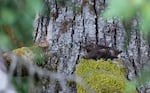
This photo released by Oregon State University shows a marbled murrelet nesting on moss in a coastal forest.
Courtesy of Brett Lovelace/OSU
Scientists at Oregon State University set up cameras and recorded 12,000 hours of video footage to track changes in how marbled murrelets feed their chicks across four years of varying ocean conditions.
Poor ocean conditions, for example, are generally associated with warmer marine temperatures that can affect the availability of fish like Pacific sand lance the small, stocky seabirds catch to feed their chicks.
The scientists found that not only did the chicks receive fewer fish per day during poor ocean conditions, they also took 25% longer to leave the nest, which made them more vulnerable to being eaten by predators like ravens and hawks. That raises concerns for the future of a species that’s listed as threatened in California, Oregon and Washington under the Endangered Species Act.
Climate change is affecting marbled murrelets’ population recovery by making marine temperatures warmer and El Niño events stronger, and harming the old-growth conifer forests where the birds nest.
Jim Rivers is an associate professor of wildlife ecology and the director of the Forest Animal Ecology Lab at OSU. He joins us for more details.
Note: The following transcript was transcribed digitally and validated for accuracy, readability and formatting by an OPB volunteer.
Dave Miller: This is Think Out Loud on OPB. I’m Dave Miller. We turn now to marbled murrelets. They’ve been called the “enigma of the Pacific.” They’re a fascinating, elusive and threatened seabird species that feed on ocean fish but nest in old growth as many as 60 miles inland. Scientists at Oregon State University recently published a new study about the birds based on years of research. They found that poor ocean conditions have a direct effect on how parents feed their chicks, and how long it takes for those chicks to fledge.
Jim Rivers is an associate professor of wildlife ecology at OSU, and he joins us now. It’s great to have you on Think Out Loud.
Jim Rivers: Thanks for having me.
Miller: Why have these birds been called the “enigma of the Pacific?”
Rivers: Marbled murrelets are a species that, for a long time, we didn’t know where they nested. We had evidence that there were chicks or fledglings that were making their way to the ocean that were on the ground, but we didn’t know whether they came from a nest on the ground or were actually originating from a nest in a tree. And it wasn’t until 1974 that Western scientists finally documented their nests in a tree in Big Basin Park in California.
What we know about murrelets is that, as you mentioned, they’re birds of two worlds. They get all their food from the ocean, but they nest inland. And because they can nest dozens of miles inland, they do so singly, and it’s extremely challenging to locate their nests because they could be in any one of many tracks as you go from the coast into the interior.
Miller: Can you describe what marbled murrelets look like?
Rivers: Murrelets are a stocky bird. They’re in the auk family, so they’re related to puffins and murres, and they’re about the size of an American robin. And unlike other members of the auk family, like tufted puffins, for example, which have very elaborate feathers during the breeding season, murrelets go the opposite way. They actually molt into feathers that are very speckled and brown, and help to camouflage them at the nest site.
They’re not very big. They’re very fast fliers. We have evidence that they can fly upwards of 100 miles an hour, believe it or not. And when they move inland to their nest sites, they do so under low light conditions, whether they’re going in to incubate the egg or whether they’re bringing food into the chick. So they’re hard to see, they’re hard to locate, and that’s yet another reason why we think of them as an enigma.
Miller: How likely is it that somebody could see these birds in the wild?
Rivers: There are good places to see murrelets. Cape Perpetua is one area on the Oregon coast. And in fact, the campground there, murrelets can come in during the breeding season and fly right over the campground. And if you know what you’re looking for and what you’re listening for, you can either see them or hear them calling.
More generally, they’re birds that occur in the near shore environment, so they’re usually within about a mile of shore. But because they’re so small, you really have to have a really good set of binoculars or a spotting scope, and to know a bit what you’re looking for to be able to have a sure identification.
Miller: So let’s turn to this new study. Can you describe what you and your team had to do to get thousands of hours of video footage of nesting murrelets?
Rivers: Finding their nests is a really, really big lift logistically. The way that we start finding nests is actually not by going into the forest, but by going out on the ocean at night during the late spring, early summer period. And what we do is we actually capture birds at night and we put on tracking tags. Those tracking tags give off a signal in the very high frequency range that the birds can’t hear, but we can listen in through our receivers that we have.
Once we have a bird and we release it with one of those tags, we then monitor it for a period of, essentially the rest of the summer, usually about two-and-a-half months or so. What we look for is evidence that that bird is in the ocean one day, and then it’s missing from the area that we’re looking for it the next. And when I say an area, we’re talking about an 80-mile stretch of ocean where we were listening for these birds every single day.
Because murrelets have a 24-hour incubation period – that is to say each male and female will go in and swap for 24 hours at a time – what we do is we listen for the bird being present in the ocean on one day, and then missing from the ocean the next, and back in the ocean the third day. That gives us a sense that these birds have a nest.
At that point, we start moving inland. It’s impractical to try and find these nests from the ground as a first step, so we get into fixed wing aircraft to try and locate that radio signal. Once the aircraft gets a relatively good fix on where that location is, our ground crew goes in, and then their job is to try and figure out which tree the bird might be nesting in. And that typically involves going out in the pre-dawn hours and literally looking for the birds to be coming and going from the nest tree. That may take a couple of days. It may take more than that, depending on the terrain and the particular site.
Then once we have what we think is a good sense of where the nest is and within a particular tree, we have a tree climber who climbs up an adjacent tree and then puts on a security camera that has a really good zoom so we can zoom right to the nest site. And the goal of our study was to understand what the limiting factors for murrelets to be successful at their nests were. But we were able to take all of the footage that we got and ask other questions, like what are parents bringing back to the nest to feed chicks? How does that vary with time of day? How does that vary with ocean conditions?
Miller: And that’s one of the big findings as I understand it from this new report, because you ended up comparing a number of different years that had different ocean conditions. What’s the big difference between what, from a murrelet’s perspective, you would call a good ocean year versus a bad ocean year?
Rivers: From a murrelet’s perspective, a good ocean year is one where there is abundant and plentiful forage fish. Murrelets eat forage fish. They also eat crustaceans like krill as adults, but when they’re feeding their young, they only feed their young single forage fish. And it sounds kind of crazy, but you can imagine that these birds are catching one fish and they’re flying inland to this nest site that may be dozens of miles inland, dropping off that fish to the chick, and then going back to the ocean. So for them to be successful nesters, they need to have the food resources in the marine environment that they can bring in to that chick that’s sitting there waiting for the food.
Miller: And what makes it more likely that there would be lots of smelt, anchovy, herring or other fish that the birds want to take back, one by one, to their hungry young?
Rivers: The conditions that are good for murrelet nesting are kind of our typical upwelling conditions on the Oregon coast, where we have a lot of nutrient-rich water that’s coming up and kind of kickstarting the food chain, if you will. Forage fish are towards the end of that food chain. When the conditions are good, when we have those cool waters, when we have upwelling, that bodes well for murrelets to be able to attempt to nest. Now, that’s not to say they’re definitely going to be successful, because there are a lot of different factors that can influence whether a nest does produce an offspring. But as a starting point, they need to have good food resources.
Miller: So how did murrelets respond to these different ocean conditions? What was their behavior like when it was cool water with a lot of upwelling, and what was it like when it was the opposite?
Rivers: The first year of our study was 2017. To our surprise, we tagged a lot of birds and waited for them to go inland to their nests, and we found that none of the birds that we tagged went inland. And part of the reason was that was a particularly poor year in terms of ocean conditions for murrelets. 2018 and 2019 were the years that followed, and those were also poor conditions, but we did have some birds nest in those years.
Then in 2021 and 2022, those were the more favorable conditions in the ocean for murrelets. What we found was in the more favorable years, birds were making more deliveries to the nest to that chick each day. So the difference between the more favorable years and the poor years was about 25% in terms of the number of visits that are made.
Now, murrelets don’t make a lot of visits in the first place, so we’re talking about the difference of maybe one fish a day. We also saw that there were more days where murrelets didn’t deliver any fish to the chick during poor ocean conditions. That was quite rare during the periods when ocean conditions were more favorable.
Miller: My understanding is that this means it takes longer for a chick to become full grown and longer for them then to fledge, to go out on their own. What does that mean for their likelihood of survival?
Rivers: Murrelets are a species that have a number of different nest predators, species like stellar’s jays and common ravens. We even documented some red-tailed hawks that were depredating some of our nests that had chicks. And from an evolutionary standpoint, murrelets have some flexibility in their growth, and that means they can stay on the nest longer. However, every day that a murrelet stays on the nest longer is exposed to predators for more time. So if a murrelet “wants to” do the best thing for itself, it wants to get off of that nest as soon as possible and get out to the ocean. But if ocean conditions are poor, that chick isn’t getting enough food and it’s not able to hit those growth marks as it might during a more favorable year, then it spends more time on the nest and then it has greater exposure to nest predators.
Miller: We’ve been talking a lot about ocean conditions, but what’s the status overall of the inland habitats where these birds like to make their homes and need to go if they’re going to raise young?
Rivers: Murrelets are listed under the Endangered Species Act as threatened, and a large part of that is because of the threats that they face from loss and fragmentation of their breeding habitat. So for murrelets to be successful in nesting, they’re birds of two worlds, and they have to have good habitat on the ocean to get fish for themselves and for their chicks, and they have to have good habitat on the terrestrial side of things.
So the loss and fragmentation of murrelet habitat is something that has continued over time. That is a concern for the recovery of the species, making sure that the areas that we have that are late successional and old growth forests are maintained as such so that murrelets have those areas that they need to nest in.
Miller: What might this mega El Niño year mean for marbled murrelets?
Rivers: Well, based on our study, I mentioned, the first year, we didn’t have any birds nesting at all. And what was surprising was not only did the birds forego nesting, but they actually moved out of our study area. We had quite a few birds that moved into Southern Oregon and California, and some even went up into Washington. So based on that year of study, and based on what we know about the predictions from this forthcoming El Niño, I think it’s fair to say that murrelet reproduction will be decreased by quite a bit. And in fact, there may be the case that there isn’t sufficient food sources for those birds to nest at all in some parts of the Oregon coast.
Miller: And in a sense, just like people who make the decision, “now is not a good time, I don’t have the resources to start a family,” murrelets are making that same decision. There’s not enough anchovies here, we’re not gonna mate.
Rivers: Yeah, that’s right. Murrelets are relatively long lived for their size. Even though they’re the size of a robin, we think that they may live anywhere from 12 to 15 or even longer than that, 15 years. So murrelets, in a sense, have the option of foregoing breeding in one year and then coming back when conditions are better.
The challenge with that is that when we were talking about recovering murrelet populations, one of the big factors that we want to see change is productivity. And productivity are the number of chicks that are produced each year, new members going into the population. So with poor ocean conditions and with a lack of nesting, that productivity isn’t there for a given year, and in some cases it may extend over multiple years if those effects extend over multiple years as well.
Miller: I started by asking you about this phrase “the enigma of the Pacific,” and it seems like some of those puzzle pieces have been filled in. You now know where they nest. It wasn’t seen by scientists until about 50 years ago, now you know. But just briefly, what’s a big question you still have? You have 40 seconds for that answer.
Rivers: [Laughs] Forty seconds. Some of the murrelet needs … Well, even though we found nests, we didn’t find as many as we’d hoped for. And we also focused our work on the central Oregon coast. So if we’re thinking more broadly about Oregon, considering where these birds are nesting, north of Newport, south of Newport, I think that’s an important question. And then also how successful they are over time, particularly in those stands that we know they’re nesting in, whether or not those stands are used in the future. We know the answer to that question, but we don’t know how good they are. So if a stand produces a chick in one year, is it going to do the same in the second year, in the third year and so on?
Miller: Jim Rivers, that was exactly 40 seconds. Thank you so much for joining us.
Rivers: Thank you very much, Dave, appreciate it.
Miller: That is Jim Rivers. He is an associate professor of wildlife ecology and the director of the Forest Animal Ecology Lab at Oregon State University.
“Think Out Loud®” broadcasts live at noon every day and rebroadcasts at 8 p.m.
If you’d like to comment on any of the topics in this show or suggest a topic of your own, please get in touch with us on Facebook, send an email to thinkoutloud@opb.org, or you can leave a voicemail for us at 503-293-1983.
